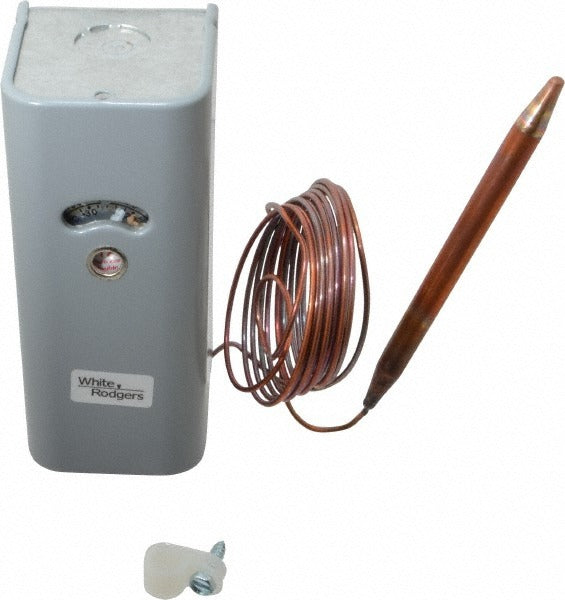
The WHITE-RODGERS 16 87 009S1 is a refrigeration temperature control designed for precise temperature sensing and switching in commercial and light-commercial refrigeration systems. It uses an 8-foot capillary tube to sense temperature at the point of application and triggers an SPDT (single-pole, double-throw) switch output when the set point is reached. The differential is field-adjustable across a range of 4.5 to 40 degrees F, giving the technician control over how tightly or broadly the system cycles. This type of control is typically installed by refrigeration mechanics and HVAC-R technicians performing system commissioning or component replacement.
This control is suited for walk-in coolers, reach-in cases, refrigerated display cases, and similar refrigeration applications where reliable thermostat switching is required. The SPDT switch action supports both normally open and normally closed circuit configurations, making it adaptable to a range of control wiring schemes. The adjustable differential allows the installer to dial in cycle frequency based on the load requirements of the specific refrigerated space.
Key Features
8-foot capillary tube for remote temperature sensing at the controlled space or evaporator
SPDT switch action supports normally open and normally closed wiring configurations
Field-adjustable differential from 4.5 to 40 degrees F for flexible cycle control
Compact design suited for panel or cabinet mounting in refrigeration equipment
Single-unit packaging with a minimum order quantity of 1
Compatibility
Designed as an OEM-style replacement temperature control for commercial and light-commercial refrigeration equipment requiring an SPDT capillary-type thermostat with an 8-foot sensing tube.
Installation Notes
Installation should be performed by a qualified HVAC-R technician or refrigeration mechanic. Disconnect and lock out all electrical power to the unit before removing the existing control or routing the capillary tube. Route the capillary carefully to avoid kinking, sharp bends, or contact with moving parts. Wiring must comply with applicable local electrical codes and the equipment manufacturer's wiring diagram.