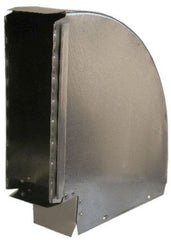
The SNAPPY 290-22 is a galvanized steel longway 90-degree stack elbow designed for rectangular sheet metal duct systems. It makes a 90-degree turn along the long dimension of the duct, allowing installers to route trunk lines and stack ducts through tight framing cavities without sacrificing airflow cross-section. The fitting measures 2.25 inches by 12 inches and is used in residential and light commercial forced-air HVAC installations. Sheet metal mechanics and HVAC installers work with this fitting during new construction and duct retrofit projects where a smooth, low-restriction 90-degree transition is required on the longway axis.
This elbow is suited for rectangular galvanized duct systems in residential and light commercial applications. It is commonly installed in wall cavities, floor systems, and furred-down chase assemblies where a longway 90-degree change of direction is needed on a 2.25-inch by 12-inch duct. The fitting connects to standard rectangular duct and fittings of the same cross-section and integrates into conventional slip-and-drive or S-cleat assembly methods.
Key Features
Longway 90-degree geometry routes the turn along the 12-inch dimension for maximum clearance in framed cavities
Galvanized steel construction resists corrosion in typical HVAC duct environments
2.25 x 12 inch cross-section fits standard rectangular duct of the same size
Lightweight at 0.50 pounds for easy single-hand positioning during install
Compatible with conventional slip-and-drive and S-cleat duct assembly methods
Compatibility
Designed as an OEM-style replacement and new-construction fitting for standard 2.25 x 12 inch rectangular galvanized duct systems in residential and light commercial forced-air HVAC applications.
Installation Notes
This fitting is installed by licensed HVAC technicians or sheet metal mechanics as part of a forced-air duct system. Shut down and lock out the air handler or furnace before modifying any duct section. Secure the elbow using standard S-cleats and drive cleats, and seal all joints with UL-listed foil tape or mastic per local mechanical code requirements. Do not over-crimp the fitting flanges, as deformation will affect the seating of adjacent duct sections.