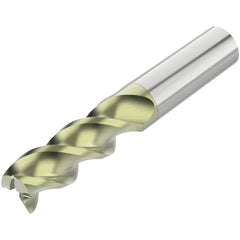
The SECO 10023018 is a single-end square end mill designed for high-performance milling in aluminum and non-ferrous materials. Built from micrograin solid carbide, it delivers rigidity and edge retention that HSS tooling cannot match at comparable speeds. The 7/16 inch cutting diameter pairs with a 1 inch length of cut and a 45-degree helix angle, promoting efficient chip evacuation and reduced heat buildup during extended passes. An ANF coating further protects the cutting edges and improves surface finish when running at aggressive feeds. This tool ships ready to mount in standard straight-shank toolholders and is installed by machinists and CNC operators in job shop and production environments.
This end mill is suited for slotting, profiling, and pocketing operations in aluminum, brass, copper, and other non-ferrous workpiece materials. The short-length geometry keeps the tool stiff and reduces deflection in shallow-to-moderate depth-of-cut applications. Right-hand cut and right-hand flute direction make it compatible with conventional vertical and horizontal milling machines as well as CNC machining centers running standard spindle rotation. The Series A345 designation places it within a defined family of SECO solid carbide end mills engineered around non-ferrous and light-alloy cutting.
Key Features
Micrograin solid carbide construction for edge sharpness and wear resistance
45-degree helix angle promotes aggressive chip evacuation in aluminum and non-ferrous cuts
ANF coating reduces built-up edge and extends tool life on non-ferrous workpieces
3-flute geometry balances chip clearance and cutting edge count for non-ferrous applications
Center-cutting design allows direct plunge entry without pre-drilling
Right-hand cut, right-hand flute, straight shank for broad toolholder compatibility
Compatibility
Designed for use in standard straight-shank end mill holders accepting a 7/16 inch shank diameter. Primary workpiece material is aluminum and non-ferrous metals. Part of the SECO Series A345 solid carbide end mill family.
Installation Notes
Installation is performed by a qualified machinist or CNC operator. Ensure the spindle is fully stopped and the machine is in a safe, locked-out state before changing tooling. Seat the shank fully into the holder and torque set screws or collet nuts to the toolholder manufacturer specification. Verify runout with a dial indicator before beginning production cuts; maximum TIR for this tool is 0.0050 inches.