


Search
-
HVAC Equipment
-
Ductless Mini Splits
- Ductless Mini Splits
- Shop By Zone
- Shop by BTU
- Shop By Brand
- Components
- Accessories
-
HVAC Parts & Supplies
- HVAC Parts & Supplies
- HVAC Supplies
- HVAC Tools
-
HVAC Replacement Parts
- Blower Housing & Assemblies
- Blower Wheels
- Breakers, Contactors & Disconnects
- Capacitors & Transformers
- Control & Circuit Boards
- Filter Driers & Accumulators
- Gas Valves & Conversion Kits
- Heat Exchangers
- Thermal Expansion Valves (TXV)
- Temperature Controls
- Wall Brackets & Parts
- Miscellaneous Parts
- O-Rings & Gaskets
- Hydronics
- Motors
- Thermostats & Zoning
-
Plumbing
-
Pool
-
Electrical
-
Air Quality
-
Tools & Supplies
-
Door Security & Hardware


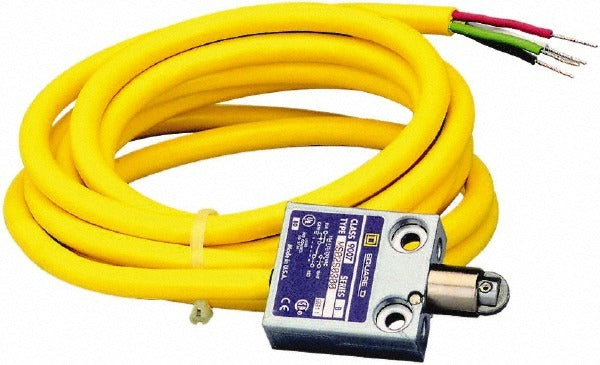
Square D 9007MS02S0500 Limit Switch Spdt Nc Roller Plunger

Availability:
Out Of Stock
- $217.37
- $217.37
- Unit price
- / per
✓
Better Price in Cart
Manufacturer pricing rules prevent us from advertising our discount — no account or email required to see it.
-
Secure Payments
-
Easy Returns
-
Expert Advice
-
Fast Shipping
Product Description
The SQUARE D 9007MS02S0500 is a general-purpose limit switch rated for SPDT contact form with a normally closed (NC) configuration. It uses a side-mounted roller plunger actuator and comes factory prewired for straightforward installation. Rated at 240 volts AC and carrying an IP67 ingress protection rating, this switch is built for reliable position detection in wet, dusty, or otherwise demanding industrial and commercial environments. The zinc body provides solid construction without excessive weight. Licensed electricians and automation technicians install this type of switch for machine guarding, conveyor positioning, door interlocking, and similar control applications.
This limit switch is suited for both light industrial and commercial control panel applications where a compact, prewired SPDT switch must sense mechanical position or travel. The side-mounted roller plunger orientation makes it a practical choice when the actuating force approaches from the side of the switch body rather than the top. It meets NEMA ratings 1, 2, 4, 6, and 6P, making it appropriate for general indoor use, drip-proof, watertight, and submersible enclosure classifications. The operating temperature range of -40 degrees F to 220 degrees F supports use in refrigerated spaces as well as warm mechanical rooms.
Key Features
- SPDT contact form with normally closed (NC) configuration for fail-safe circuit design
- Side-mounted roller plunger actuator for lateral actuation applications
- IP67 ingress protection rating — dust-tight and submersion-resistant up to 1 meter
- NEMA ratings 1, 2, 4, 6, and 6P for broad enclosure compatibility
- Wide operating temperature range: -40 degrees F to 220 degrees F
- Factory prewired terminals eliminate field wiring of switch contacts
- CE, CSA Certified, UL Listed, and RoHS Compliant
Compatibility
Designed as an OEM-style or replacement general-purpose limit switch for industrial control, machine tool, and conveyor systems requiring a side-actuated SPDT roller plunger switch at 240 volts AC.
Installation Notes
Installation should be performed by a qualified electrician in accordance with the NEC and any applicable local codes. De-energize and lock out the circuit before mounting or wiring the switch. Secure the switch body to a rigid mounting surface so the roller plunger aligns correctly with the actuating cam or dog to avoid side-loading that could damage the actuator over time. Verify all prewired lead connections at the control panel termination points before restoring power.
Technical Specifications

Complete your install
We pulled together the parts most installs need for this unit, plus a few add-ons worth a look. Check what you need — nothing here blocks checkout.
Loading install accessories...
Add install kit to cart
—
Related Products
- Choosing a selection results in a full page refresh.