


Search
-
HVAC Equipment
-
Ductless Mini Splits
- Ductless Mini Splits
- Shop By Zone
- Shop by BTU
- Shop By Brand
- Components
- Accessories
-
HVAC Parts & Supplies
- HVAC Parts & Supplies
- HVAC Supplies
- HVAC Tools
-
HVAC Replacement Parts
- Blower Housing & Assemblies
- Blower Wheels
- Breakers, Contactors & Disconnects
- Capacitors & Transformers
- Control & Circuit Boards
- Filter Driers & Accumulators
- Gas Valves & Conversion Kits
- Heat Exchangers
- Thermal Expansion Valves (TXV)
- Temperature Controls
- Wall Brackets & Parts
- Miscellaneous Parts
- O-Rings & Gaskets
- Hydronics
- Motors
- Thermostats & Zoning
-
Plumbing
-
Pool
-
Electrical
-
Air Quality
-
Tools & Supplies
-
Door Security & Hardware


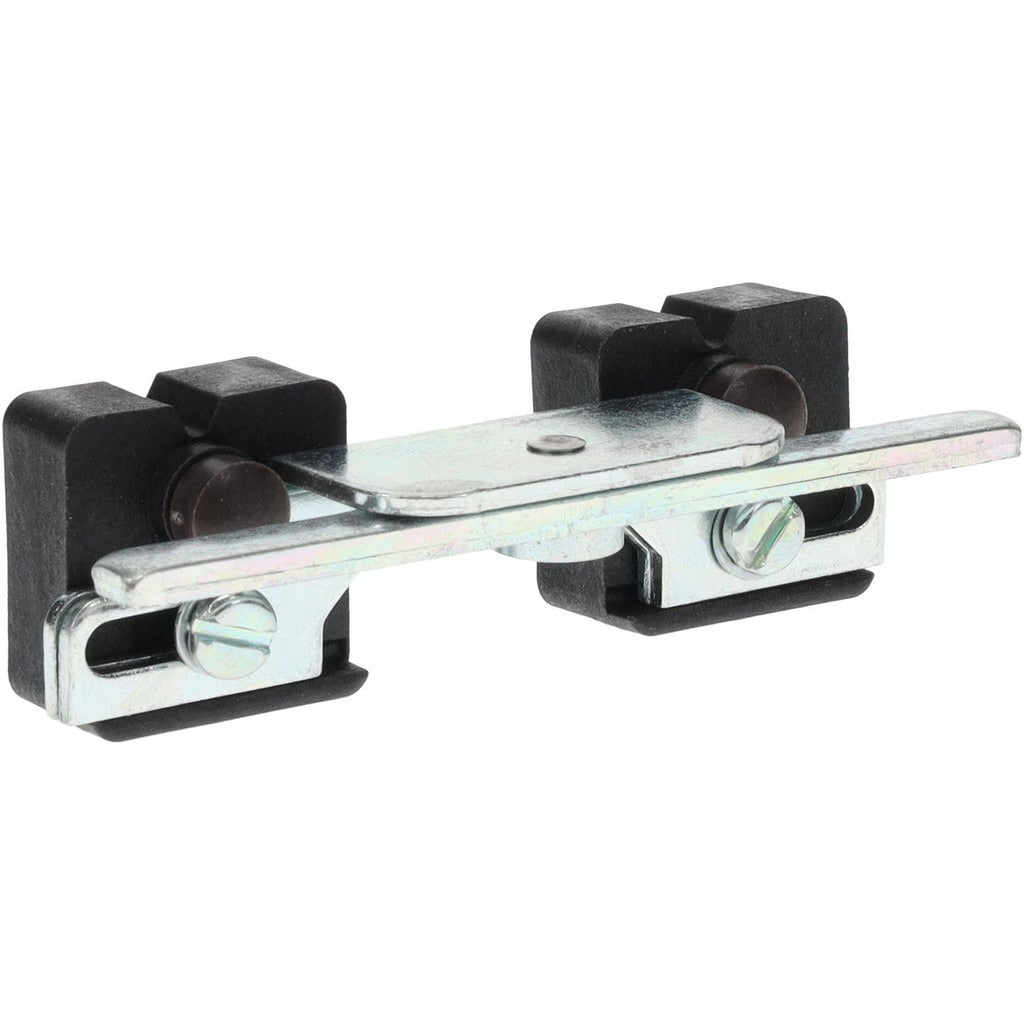
Schneider Electric 9001K3 Pushbutton Switch Interlock

Availability:
In Stock
Ships same day if ordered by 12 pm
- $64.87
- $64.87
- Unit price
- / per
✓
Better Price in Cart
Manufacturer pricing rules prevent us from advertising our discount — no account or email required to see it.
-
Secure Payments
-
Easy Returns
-
Expert Advice
-
Fast Shipping
Product Description
The SCHNEIDER ELECTRIC 9001K3 is a mechanical interlock accessory designed for 30 mm pushbutton operator assemblies. It prevents two adjacent pushbuttons from being depressed simultaneously, enforcing a mutually exclusive switching action at the control station. The 9001K3 mounts directly between compatible operators and requires no additional tools beyond what is needed to assemble the pushbutton unit itself. Electricians and control panel builders use this component when wiring start/stop, forward/reverse, or other interlock-logic sequences into industrial control enclosures. The part weighs 0.13 pounds and fits within a compact footprint of 2 inches long by 4.5 inches wide by 2.3 inches tall.
This interlock accessory is intended for use in industrial and commercial control panel applications where mechanically interlocked pushbutton logic is required. Typical install scenarios include motor control stations, machine operator panels, and process control enclosures where two discrete pushbutton operators must be physically prevented from engaging at the same time. It is compatible with the Harmony 9001K, 9001SK, and 9001KX series 30 mm pushbutton platforms, as well as mechanically interlocked pushbutton assemblies using 9001KR11 and 9001KR12 operators.
Key Features
- Mechanical interlock action physically prevents simultaneous depression of two adjacent pushbutton operators
- Designed for 30 mm operator format used across the Harmony 9001K, 9001SK, and 9001KX series
- Compact form factor: 2 inches long, 4.5 inches wide, 2.3 inches tall
- Lightweight at 0.13 pounds, adding minimal mass to the assembled control station
- Single-unit packaging with a minimum order quantity of one, suited for maintenance and replacement use
Compatibility
Compatible with 9001KR11 operators, 9001KR12 operators, Harmony 9001K, 9001SK, and 9001KX 30 mm pushbuttons, and mechanically interlocked pushbutton assemblies as stated by the manufacturer.
Installation Notes
Installation is performed by a licensed electrician or qualified control panel technician. De-energize the control panel and lock out the power source following NFPA 70E arc flash and lockout/tagout procedures before disassembling any pushbutton station. The interlock body installs between the two operator units during assembly of the pushbutton block; refer to the manufacturer wiring and assembly documentation for proper orientation. Do not force the interlock into position, as misalignment can prevent correct mechanical action.
Technical Specifications

Complete your install
We pulled together the parts most installs need for this unit, plus a few add-ons worth a look. Check what you need — nothing here blocks checkout.
Loading install accessories...
Add install kit to cart
—
Related Products
- Choosing a selection results in a full page refresh.