


Search
-
HVAC Equipment
-
Ductless Mini Splits
- Ductless Mini Splits
- Shop By Zone
- Shop by BTU
- Shop By Brand
- Components
- Accessories
-
HVAC Parts & Supplies
- HVAC Parts & Supplies
- HVAC Supplies
- HVAC Tools
-
HVAC Replacement Parts
- Blower Housing & Assemblies
- Blower Wheels
- Breakers, Contactors & Disconnects
- Capacitors & Transformers
- Control & Circuit Boards
- Filter Driers & Accumulators
- Gas Valves & Conversion Kits
- Heat Exchangers
- Thermal Expansion Valves (TXV)
- Temperature Controls
- Wall Brackets & Parts
- Miscellaneous Parts
- O-Rings & Gaskets
- Hydronics
- Motors
- Thermostats & Zoning
-
Plumbing
-
Pool
-
Electrical
-
Air Quality
-
Tools & Supplies
-
Door Security & Hardware


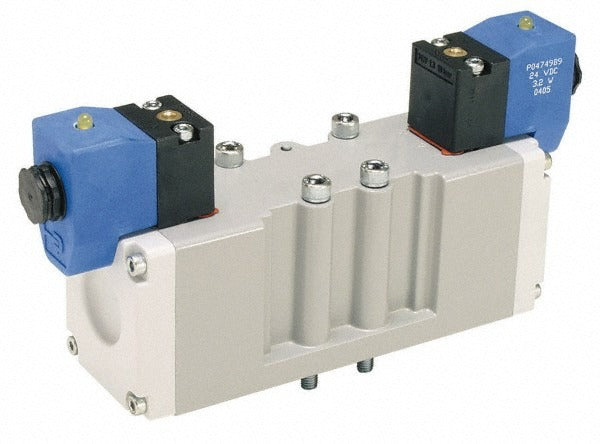
Parker H26VXBG0B9D Double Solenoid Valve 3-position
Availability:
Out Of Stock
- $602.94
- $602.94
- Unit price
- / per
✓
Better Price in Cart
Manufacturer pricing rules prevent us from advertising our discount — no account or email required to see it.

Secure Payments
-
Easy Returns
-
Expert Advice
-
Fast Shipping
Product Description
The PARKER H26VXBG0B9D is a double solenoid, 3-position directional control valve designed for pneumatic systems. In its unactuated state, the valve defaults to the center exhaust open position, allowing connected actuator ports to exhaust freely when neither solenoid is energized. The aluminum body keeps weight manageable for panel and manifold mounting applications. Nitrile seals provide reliable performance with standard compressed air and many common pneumatic media. Operating at 24 volts DC, this valve fits into standard low-voltage pneumatic control circuits. A Cv factor of 2.8 supports moderate flow demands in industrial and automation pneumatic circuits. Licensed HVAC technicians, industrial maintenance personnel, and pneumatic system integrators are the typical installers.
This valve is suited for industrial pneumatic applications where a fail-safe center exhaust condition is required. When neither solenoid is energized, actuator ports are connected to exhaust, allowing cylinders or other downstream actuators to relax to an unloaded state. This behavior is commonly specified in machine safety designs and automated assembly equipment. The 24 volt DC coil voltage integrates directly with PLCs and standard industrial control panels without additional signal conditioning.
Key Features
- 3-position, double solenoid design with center exhaust open unactuated state
- Aluminum valve body for reduced weight and corrosion resistance in standard pneumatic environments
- Nitrile seals compatible with compressed air and common pneumatic media
- 24 volt DC coil voltage for direct integration with PLC and standard industrial control circuits
- Cv factor of 2.8 suitable for moderate pneumatic flow requirements
Compatibility
Designed as an OEM-style replacement or new-installation directional control valve for industrial pneumatic circuits requiring a 3-position, center exhaust open, double solenoid configuration operating at 24 volts DC.
Installation Notes
Installation should be performed by a qualified pneumatic systems technician or industrial maintenance professional. Depressurize the pneumatic supply line and de-energize all control power before removing or installing the valve. Verify that the supply pressure and flow requirements of the application fall within the valve rating before commissioning. Follow applicable OSHA lockout/tagout procedures and local machine safety codes when servicing pneumatic control components.
Technical Specifications

Complete your install
We pulled together the parts most installs need for this unit, plus a few add-ons worth a look. Check what you need — nothing here blocks checkout.
Loading install accessories...
Add install kit to cart
—
Related Products
- Choosing a selection results in a full page refresh.