


Search
-
HVAC Equipment
-
Ductless Mini Splits
- Ductless Mini Splits
- Shop By Zone
- Shop by BTU
- Shop By Brand
- Components
- Accessories
-
HVAC Parts & Supplies
- HVAC Parts & Supplies
- HVAC Supplies
- HVAC Tools
-
HVAC Replacement Parts
- Blower Housing & Assemblies
- Blower Wheels
- Breakers, Contactors & Disconnects
- Capacitors & Transformers
- Control & Circuit Boards
- Filter Driers & Accumulators
- Gas Valves & Conversion Kits
- Heat Exchangers
- Thermal Expansion Valves (TXV)
- Temperature Controls
- Wall Brackets & Parts
- Miscellaneous Parts
- O-Rings & Gaskets
- Hydronics
- Motors
- Thermostats & Zoning
-
Plumbing
-
Pool
-
Electrical
-
Air Quality
-
Tools & Supplies
-
Door Security & Hardware


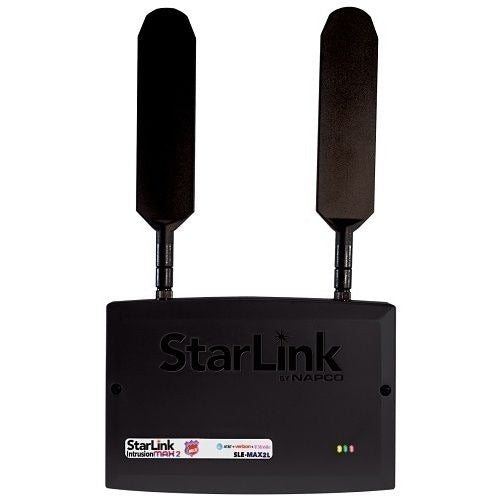
Napco sle-max2l Starlink Dual Path Fire Alarm Communicator

Availability:
In Stock
Ships same day if ordered by 12 pm
- $100.57
- $100.57
- Unit price
- / per
✓
Better Price in Cart
Manufacturer pricing rules prevent us from advertising our discount — no account or email required to see it.
-
Secure Payments
-
Easy Returns
-
Expert Advice
-
Fast Shipping
Product Description
The NAPCO sle-max2l Starlink is a commercial-grade cellular fire alarm communicator designed for dual-path signal transmission over two independent cellular networks, Verizon and ATT, using dual SIM technology. It connects to commercial fire alarm control panels and forwards life safety events to a central monitoring station. The dual-path architecture maintains communication continuity when one network path experiences an outage or degraded coverage. Licensed fire alarm technicians and low-voltage contractors are the primary installers. The sle-max2l is suited for high-demand commercial applications where uninterrupted alarm transmission is a code and insurance requirement.
The sle-max2l is intended for commercial fire protection systems requiring a UL-listed communicator with redundant cellular connectivity. It is designed to replace or supplement traditional POTS-line communicators in buildings where copper telephone infrastructure has been retired or is unreliable. Typical deployment scenarios include office buildings, retail facilities, warehouses, and other commercial occupancies where NFPA 72 compliant monitoring is required. The unit connects to the communication terminals of most commercial fire alarm control panels and supports full event reporting across both cellular paths.
Key Features
- Dual-path cellular communication using simultaneous Verizon and ATT networks via dual SIM
- Universal connection to commercial fire alarm control panels
- Full event reporting with intelligent supervision for signal integrity monitoring
- Onboard power capability supports streamlined wiring during installation
- Automatic firmware updates maintain current software without manual intervention
- Designed for both urban high-density and remote low-coverage environments
Compatibility
Designed as an OEM-style replacement or supplemental communicator for commercial fire alarm control panels requiring a dual-path cellular reporting solution.
Installation Notes
Installation must be performed by a licensed fire alarm technician in accordance with NFPA 72 and all applicable local fire codes. Shut down and isolate the fire alarm control panel before connecting the communicator to any panel terminals. Verify cellular signal strength at the installation site on both Verizon and ATT networks before finalizing mounting location. After installation, conduct a full communications test to the central monitoring station to confirm both paths report correctly before returning the system to service.
Technical Specifications

Complete your install
We pulled together the parts most installs need for this unit, plus a few add-ons worth a look. Check what you need — nothing here blocks checkout.
Loading install accessories...
Add install kit to cart
—
Related Products
- Choosing a selection results in a full page refresh.