


Search
-
HVAC Equipment
-
Ductless Mini Splits
- Ductless Mini Splits
- Shop By Zone
- Shop by BTU
- Shop By Brand
- Components
- Accessories
-
HVAC Parts & Supplies
- HVAC Parts & Supplies
- HVAC Supplies
- HVAC Tools
-
HVAC Replacement Parts
- Blower Housing & Assemblies
- Blower Wheels
- Breakers, Contactors & Disconnects
- Capacitors & Transformers
- Control & Circuit Boards
- Filter Driers & Accumulators
- Gas Valves & Conversion Kits
- Heat Exchangers
- Thermal Expansion Valves (TXV)
- Temperature Controls
- Wall Brackets & Parts
- Miscellaneous Parts
- O-Rings & Gaskets
- Hydronics
- Motors
- Thermostats & Zoning
-
Plumbing
-
Pool
-
Electrical
-
Air Quality
-
Tools & Supplies
-
Door Security & Hardware


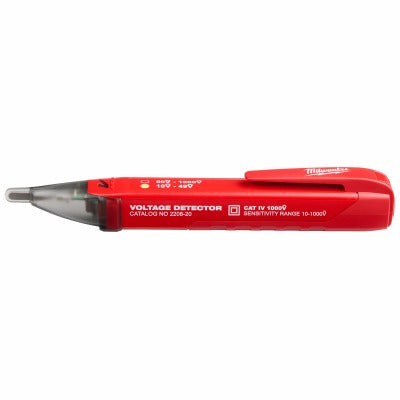
Milwaukee 2208-20 Dual Range Voltage Detector 10-1000V Ac

Availability:
Out Of Stock
Ships in 3 - 4 Business Days
- $226.77
- $226.77
- Unit price
- / per
✓
Better Price in Cart
Manufacturer pricing rules prevent us from advertising our discount — no account or email required to see it.
-
Secure Payments
-
Easy Returns
-
Expert Advice
-
Fast Shipping
Product Description
The MILWAUKEE ELECTRIC TOOL CORP 2208-20 is a dual-range non-contact voltage detector designed for commercial and residential electrical work. It covers two detection ranges: a low-voltage range of 10-49 volts AC and a standard range of 50-1000 volts AC. The unit automatically differentiates between the two ranges using distinct LED indicator colors and separate audible tones, eliminating guesswork during live-circuit testing. Electricians, low-voltage technicians, and facilities maintenance technicians use this tool when standard single-range detectors would miss low-level AC signals common in modern installations.
The 2208-20 is well-suited for testing and verifying voltage presence in LED lighting circuits, fire detection and suppression systems, HVAC control wiring, and security and access control systems. These low-voltage circuits typically operate below 50 volts AC and fall outside the detection threshold of conventional non-contact voltage detectors. The expanded 10-49 volt sensitivity range closes that gap for both commercial service work and residential troubleshooting where mixed low-voltage and line-voltage wiring is present in the same installation.
Key Features
- Detects AC voltage from 10 volts to 1000 volts in a single tool
- Automatically differentiates 10-49V low-voltage range from 50-1000V standard range
- Uniquely colored LED indicators paired with distinct audible tones for each range
- Suitable for LED lighting, fire suppression, HVAC controls, and security access control circuits
- Non-contact detection reduces exposure risk during live-circuit identification
Compatibility
Designed for use in commercial and residential electrical applications where both low-voltage AC circuits (10-49V) and standard line-voltage AC circuits (50-1000V) are present, including LED lighting systems, fire detection and suppression systems, HVAC control wiring, and security and access control systems.
Installation Notes
This tool is intended for use by licensed electricians, low-voltage technicians, and qualified facilities maintenance personnel. Always verify detector function on a known live source before and after testing an unknown circuit. Follow applicable NFPA 70E arc flash and shock hazard precautions for the voltage class being tested. Do not use this device as the sole means of confirming a circuit is de-energized before performing work.
Technical Specifications

Complete your install
We pulled together the parts most installs need for this unit, plus a few add-ons worth a look. Check what you need — nothing here blocks checkout.
Loading install accessories...
Add install kit to cart
—
Related Products
- Choosing a selection results in a full page refresh.