


Search
-
HVAC Equipment
-
Ductless Mini Splits
- Ductless Mini Splits
- Shop By Zone
- Shop by BTU
- Shop By Brand
- Components
- Accessories
-
HVAC Parts & Supplies
- HVAC Parts & Supplies
- HVAC Supplies
- HVAC Tools
-
HVAC Replacement Parts
- Blower Housing & Assemblies
- Blower Wheels
- Breakers, Contactors & Disconnects
- Capacitors & Transformers
- Control & Circuit Boards
- Filter Driers & Accumulators
- Gas Valves & Conversion Kits
- Heat Exchangers
- Thermal Expansion Valves (TXV)
- Temperature Controls
- Wall Brackets & Parts
- Miscellaneous Parts
- O-Rings & Gaskets
- Hydronics
- Motors
- Thermostats & Zoning
-
Plumbing
-
Pool
-
Electrical
-
Air Quality
-
Tools & Supplies
-
Door Security & Hardware


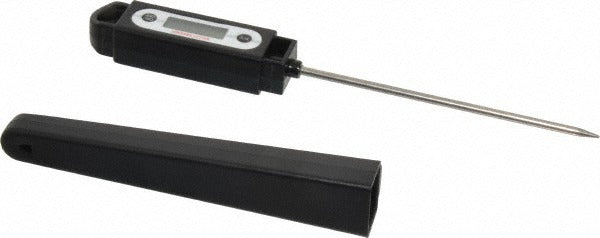
General DT655HFC Solar Powered Digital Thermometer

Availability:
Out Of Stock
- $60.83
- $60.83
- Unit price
- / per
✓
Better Price in Cart
Manufacturer pricing rules prevent us from advertising our discount — no account or email required to see it.
-
Secure Payments
-
Easy Returns
-
Expert Advice
-
Fast Shipping
Product Description
The GENERAL DT655HFC is a solar-powered digital thermometer designed for temperature monitoring across a wide range of trade and industrial applications. Powered by ambient light, the unit eliminates battery replacement concerns in field and fixed-mount installations. It uses a thermistor sensor for temperature input and displays readings on an integrated LCD screen. The DT655HFC covers a broad measurement range, reaching up to 536 degrees F on the high end and down to -50 degrees C on the low end, making it suitable for high-temperature process monitoring, HVAC diagnostics, and general service work. Accuracy is rated at plus or minus 3 degrees. HVAC technicians, plumbers, and industrial service professionals are the typical end users.
The DT655HFC fits general-purpose temperature measurement tasks where a battery-free, solar-powered solution is preferred. Typical applications include monitoring supply and return air temperatures, surface temperature checks on piping, and ambient condition logging in equipment rooms or mechanical spaces. The solar power design suits installations in locations with consistent light exposure where routine battery service is inconvenient. The LCD display provides a clear, direct readout without requiring a secondary device or datalogger.
Key Features
- Solar-powered operation eliminates the need for battery replacement
- Thermistor sensor input for reliable temperature measurement
- Measurement range up to 536 degrees F and down to -50 degrees C
- LCD display for direct, easy-to-read temperature output
- Accuracy rated at plus or minus 3 degrees
- Lightweight at 0.1 pounds for easy handling and portable use
Compatibility
Designed as a general-purpose solar-powered digital thermometer suitable for HVAC, plumbing, and industrial service applications where thermistor-based temperature measurement is required.
Installation Notes
Installation and use of this thermometer should be performed by qualified HVAC technicians or service professionals familiar with temperature measurement instruments. Ensure the solar panel has adequate light exposure for consistent operation. When taking measurements near energized electrical equipment or pressurized systems, follow applicable safety protocols and de-energize or depressurize equipment before making contact with sensor leads. Refer to the manufacturer documentation for proper sensor placement and connection procedures.
Technical Specifications

Complete your install
We pulled together the parts most installs need for this unit, plus a few add-ons worth a look. Check what you need — nothing here blocks checkout.
Loading install accessories...
Add install kit to cart
—
Related Products
- Choosing a selection results in a full page refresh.