


Search
-
HVAC Equipment
-
Ductless Mini Splits
- Ductless Mini Splits
- Shop By Zone
- Shop by BTU
- Shop By Brand
- Components
- Accessories
-
HVAC Parts & Supplies
- HVAC Parts & Supplies
- HVAC Supplies
- HVAC Tools
-
HVAC Replacement Parts
- Blower Housing & Assemblies
- Blower Wheels
- Breakers, Contactors & Disconnects
- Capacitors & Transformers
- Control & Circuit Boards
- Filter Driers & Accumulators
- Gas Valves & Conversion Kits
- Heat Exchangers
- Thermal Expansion Valves (TXV)
- Temperature Controls
- Wall Brackets & Parts
- Miscellaneous Parts
- O-Rings & Gaskets
- Hydronics
- Motors
- Thermostats & Zoning
-
Plumbing
-
Pool
-
Electrical
-
Air Quality
-
Tools & Supplies
-
Door Security & Hardware


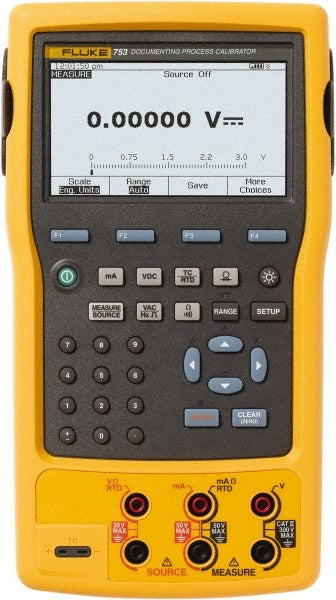
Fluke FLUKE-753 Documenting Process Calibrator

Availability:
Out Of Stock
- $10,409.56
- $10,409.56
- Unit price
- / per
✓
Better Price in Cart
Manufacturer pricing rules prevent us from advertising our discount — no account or email required to see it.
-
Secure Payments
-
Easy Returns
-
Expert Advice
-
Fast Shipping
Product Description
The FLUKE FLUKE-753 is a documenting process calibrator built for field technicians and instrumentation professionals who need to source, simulate, and measure electrical process signals. It measures DC current up to 100 milliamps (mA) and sources up to 22 mA, covering standard 4-20 mA process loops. The calibrator also handles resistance up to 10,000 ohms and frequency signals up to 50 kHz. With support for 13 thermocouple (TC) types and 8 RTD types, it covers a wide range of temperature sensor calibration tasks in a single instrument. Rated for 300 VAC and 300 VDC, it is suited for use in industrial process environments where both accuracy and documentation are required.
The FLUKE-753 is used in industrial and commercial facilities to calibrate transmitters, sensors, and control loops. Instrumentation technicians rely on it for commissioning, maintenance, and troubleshooting of 4-20 mA current loops, temperature sensors, and frequency-based process signals. It is appropriate for both standalone field calibration and documented calibration programs where pass/fail records and min/max logging are needed. Its combination of sourcing, measuring, and simulation capabilities reduces the number of instruments a technician needs to carry on a job.
Key Features
- Measures DC current up to 100 mA and sources up to 22 mA for 4-20 mA loop calibration
- Supports 13 thermocouple types and 8 RTD types for broad temperature sensor coverage
- Resistance measurement up to 10,000 ohms and frequency up to 50 kHz
- Rated for 300 VAC and 300 VDC input
- Min/Max capture function for tracking signal excursions during calibration
- 3-year manufacturer warranty
Compatibility
Designed for use with standard 4-20 mA process loops, thermocouple and RTD temperature sensors, and frequency-based process transmitters in industrial instrumentation applications.
Installation Notes
The FLUKE-753 is serviced and operated by licensed instrumentation technicians or qualified process calibration personnel. Before connecting to any live loop or transmitter, de-energize or isolate the circuit per facility lockout/tagout procedures. Follow applicable electrical safety standards when working near voltages at or near the 300 V rated limit. Verify instrument calibration status and battery condition before beginning a calibration procedure.
Technical Specifications

Complete your install
We pulled together the parts most installs need for this unit, plus a few add-ons worth a look. Check what you need — nothing here blocks checkout.
Loading install accessories...
Add install kit to cart
—
Related Products
- Choosing a selection results in a full page refresh.