


Search
-
HVAC Equipment
-
Ductless Mini Splits
- Ductless Mini Splits
- Shop By Zone
- Shop by BTU
- Shop By Brand
- Components
- Accessories
-
HVAC Parts & Supplies
- HVAC Parts & Supplies
- HVAC Supplies
- HVAC Tools
-
HVAC Replacement Parts
- Blower Housing & Assemblies
- Blower Wheels
- Breakers, Contactors & Disconnects
- Capacitors & Transformers
- Control & Circuit Boards
- Filter Driers & Accumulators
- Gas Valves & Conversion Kits
- Heat Exchangers
- Thermal Expansion Valves (TXV)
- Temperature Controls
- Wall Brackets & Parts
- Miscellaneous Parts
- O-Rings & Gaskets
- Hydronics
- Motors
- Thermostats & Zoning
-
Plumbing
-
Pool
-
Electrical
-
Air Quality
-
Tools & Supplies
-
Door Security & Hardware


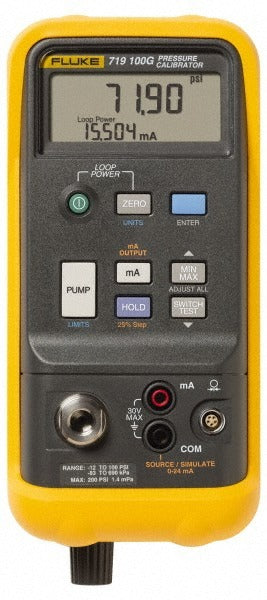
Fluke FLUKE-719 30G Handheld Pressure Calibrator 30 Psi

Availability:
In Stock
Ships same day if ordered by 12 pm
- $5,765.08
- $5,765.08
- Unit price
- / per
✓
Better Price in Cart
Manufacturer pricing rules prevent us from advertising our discount — no account or email required to see it.
-
Secure Payments
-
Easy Returns
-
Expert Advice
-
Fast Shipping
Product Description
The FLUKE FLUKE-719 30G is a handheld pressure calibrator designed for field technicians and instrumentation professionals who need accurate pressure measurement and source capability in a single portable unit. With a maximum range of 30 psi and a resolution of 0.001 psi (0.1 mbar), this calibrator delivers 0.025 percent accuracy over a 6-month interval. It operates on two 9V alkaline batteries, making it suitable for bench or field work without a power outlet. HVAC technicians, industrial maintenance techs, and instrumentation specialists use this tool to verify and calibrate pressure transmitters, transducers, and gauges.
The FLUKE-719 30G is well suited for residential and light commercial HVAC applications, process instrumentation, and any low-pressure pneumatic calibration task requiring traceable accuracy. It displays pressure in multiple units including psi and bar, giving technicians flexibility across different job specifications. The 24-volt operating voltage and handheld form factor make it practical for tight equipment rooms and rooftop units alike. It is a common choice for instrumentation calibrators working to maintain control system accuracy in building automation and process environments.
Key Features
- 30 psi maximum pressure range with 0.001 psi resolution for fine measurement capability
- 0.025 percent accuracy for 6 months, 0.035 percent accuracy for 1 year for reliable field calibration
- Displays pressure in bar and psi for versatile use across different job requirements
- Powered by two 9V alkaline batteries included in the package, no external power needed
- Handheld form factor sized for portability in field and rooftop service environments
- Part of the FLUKE 719 Series, a recognized platform in pressure calibration instrumentation
Compatibility
Designed as an OEM-specified handheld pressure calibrator suitable for verifying and calibrating pressure transmitters, transducers, and gauges in low-pressure pneumatic and HVAC instrumentation applications up to 30 psi.
Installation Notes
Calibration instruments of this type are typically serviced by licensed instrumentation technicians or qualified HVAC controls specialists. Before connecting to any live pressure system, isolate and depressurize the line being tested per site safety procedures. Verify all fittings and adapters are rated for the working pressure range before applying any pressure source. Follow applicable instrument calibration standards and local codes when documenting calibration results for regulated systems.
Technical Specifications

Complete your install
We pulled together the parts most installs need for this unit, plus a few add-ons worth a look. Check what you need — nothing here blocks checkout.
Loading install accessories...
Add install kit to cart
—
Related Products
- Choosing a selection results in a full page refresh.