


Search
-
HVAC Equipment
-
Ductless Mini Splits
- Ductless Mini Splits
- Shop By Zone
- Shop by BTU
- Shop By Brand
- Components
- Accessories
-
HVAC Parts & Supplies
- HVAC Parts & Supplies
- HVAC Supplies
- HVAC Tools
-
HVAC Replacement Parts
- Blower Housing & Assemblies
- Blower Wheels
- Breakers, Contactors & Disconnects
- Capacitors & Transformers
- Control & Circuit Boards
- Filter Driers & Accumulators
- Gas Valves & Conversion Kits
- Heat Exchangers
- Thermal Expansion Valves (TXV)
- Temperature Controls
- Wall Brackets & Parts
- Miscellaneous Parts
- O-Rings & Gaskets
- Hydronics
- Motors
- Thermostats & Zoning
-
Plumbing
-
Pool
-
Electrical
-
Air Quality
-
Tools & Supplies
-
Door Security & Hardware


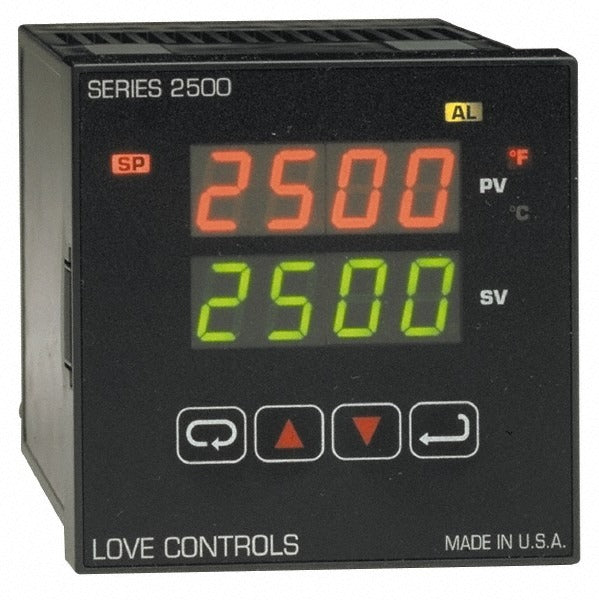
Dwyer 25013 Quarter Din Pid Temperature Controller 2500F

Availability:
Out Of Stock
- $1,890.64
- $1,890.64
- Unit price
- / per
✓
Better Price in Cart
Manufacturer pricing rules prevent us from advertising our discount — no account or email required to see it.
-
Secure Payments
-
Easy Returns
-
Expert Advice
-
Fast Shipping
Product Description
The DWYER 25013 is a quarter DIN digital PID temperature controller designed for precise process temperature management in industrial and commercial HVAC, process heating, and control panel applications. It accepts thermocouple inputs in J, K, T, E, and N sensor types and controls output through a mechanical relay. The dual 4-digit LCD display with 0.56-inch scale digits allows simultaneous viewing of setpoint and process temperature. Operating across a wide supply voltage range of 100 to 240 volts, the unit suits both domestic and international panel installations. Licensed HVAC and industrial controls technicians are the primary installers of this device.
The DWYER 25013 is suited for residential and commercial temperature control applications where a compact quarter DIN form factor is required. Typical installations include electric furnace control panels, process heating enclosures, industrial ovens, and lab or test equipment where a single-zone PID loop with relay output is sufficient. The controller handles process temperatures from -212 degrees C up to 2500 degrees F, covering a broad range of heating applications across trades.
Key Features
- PID control type for stable, accurate process temperature regulation
- Accepts five thermocouple sensor types: J, K, T, E, and N
- Dual 4-digit LCD display with 0.56-inch scale for simultaneous setpoint and process readout
- Wide supply voltage range of 100 to 240 volts accommodates varied panel power sources
- Mechanical relay output for straightforward load switching
- Quarter DIN panel-mount form factor fits standard control enclosure cutouts
Compatibility
Designed as an OEM-style replacement or new-install quarter DIN PID temperature controller compatible with standard quarter DIN panel cutouts and thermocouple sensor wiring in J, K, T, E, or N configurations.
Installation Notes
Installation of panel-mount temperature controllers should be performed by a qualified controls technician or licensed electrician in accordance with NEC guidelines. De-energize the control panel completely before wiring the controller and verify supply voltage matches the 100 to 240 volt operating range. Thermocouple leads are polarity-sensitive and must be connected using proper thermocouple extension wire matched to the sensor type in use. Confirm relay output load ratings are not exceeded before energizing the circuit.
Technical Specifications

Complete your install
We pulled together the parts most installs need for this unit, plus a few add-ons worth a look. Check what you need — nothing here blocks checkout.
Loading install accessories...
Add install kit to cart
—
Related Products
- Choosing a selection results in a full page refresh.