


Search
-
HVAC Equipment
-
Ductless Mini Splits
- Ductless Mini Splits
- Shop By Zone
- Shop by BTU
- Shop By Brand
- Components
- Accessories
-
HVAC Parts & Supplies
- HVAC Parts & Supplies
- HVAC Supplies
- HVAC Tools
-
HVAC Replacement Parts
- Blower Housing & Assemblies
- Blower Wheels
- Breakers, Contactors & Disconnects
- Capacitors & Transformers
- Control & Circuit Boards
- Filter Driers & Accumulators
- Gas Valves & Conversion Kits
- Heat Exchangers
- Thermal Expansion Valves (TXV)
- Temperature Controls
- Wall Brackets & Parts
- Miscellaneous Parts
- O-Rings & Gaskets
- Hydronics
- Motors
- Thermostats & Zoning
-
Plumbing
-
Pool
-
Electrical
-
Air Quality
-
Tools & Supplies
-
Door Security & Hardware


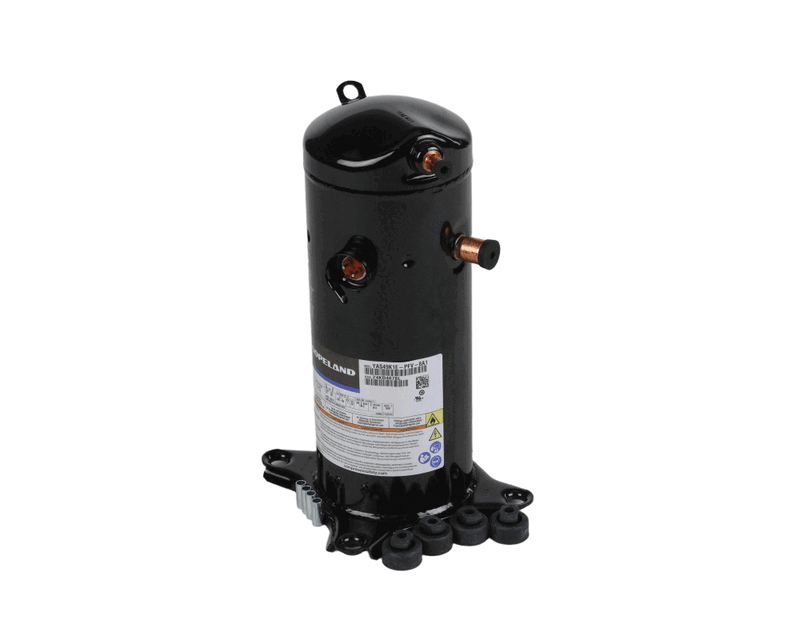
Rcd yas49k1e-pfv-8a1 Scroll Compressor 49000 Btu/h 2 Stage
Availability:
In Stock

Ships via freight in 1-3 business days
- $2,528.81
- $2,528.81
- Unit price
- / per
✓
Better Price in Cart
Manufacturer pricing rules prevent us from advertising our discount — no account or email required to see it.
LTL Delivery
This product weighs 55 lb each and will be shipped via LTL carrier. A lift gate option will be added free of charge for your convenience.
-
Secure Payments
-
Easy Returns
-
Expert Advice
-
Fast Shipping
Product Description
The RCD yas49k1e-pfv-8a1 is a two-stage scroll compressor designed for residential and light-commercial central air conditioning systems. Operating on 208-230 volts, single phase, 60 Hz, it delivers 49,000 BTU/h of cooling capacity through a two-stage compression cycle that modulates output to match load conditions. Two-stage operation reduces short cycling, lowers energy consumption at partial load, and maintains more consistent supply air temperatures compared to single-stage designs. Licensed HVAC technicians install this compressor as a direct OEM-style replacement, restoring factory performance levels in split-system and package unit applications.
This compressor is suited for split-system central air conditioning installations operating on single-phase power at 208-230 volts. The two-stage scroll design supports variable demand cooling, making it appropriate for residential applications where comfort consistency and runtime efficiency are priorities. It is dimensioned for standard compressor compartments and connects to existing refrigerant lines and electrical controls using OEM-matched interfaces. Technicians replacing a failed compressor in a matched-system installation will find the electrical and mechanical interface consistent with factory specifications.
Key Features
- Two-stage scroll compression for balanced capacity modulation and reduced short cycling
- 49,000 BTU/h rated cooling capacity for residential and light-commercial tonnage applications
- 208-230 volt, single-phase, 60 Hz electrical configuration matches standard residential power supply
- OEM-style replacement design supports fitment with existing controls and refrigerant circuit components
- Scroll compressor technology provides quieter operation and fewer moving parts compared to reciprocating designs
Compatibility
Designed as an OEM-style replacement scroll compressor for single-phase residential and light-commercial central air conditioning systems rated at 49,000 BTU/h with 208-230 volt power supply.
Installation Notes
Installation must be performed by an EPA 608-certified HVAC technician. Recover all refrigerant from the system before disconnecting the failed compressor, following EPA Section 608 recovery requirements. De-energize and lock out the disconnect before performing any electrical or mechanical work. Follow the equipment manufacturer's service instructions for oil charge verification, refrigerant type, and system evacuation depth before recharging.
Technical Specifications

Complete your install
We pulled together the parts most installs need for this unit, plus a few add-ons worth a look. Check what you need — nothing here blocks checkout.
Loading install accessories...
Add install kit to cart
—
Related Products
- Choosing a selection results in a full page refresh.