


Search
-
HVAC Equipment
-
Ductless Mini Splits
- Ductless Mini Splits
- Shop By Zone
- Shop by BTU
- Shop By Brand
- Components
- Accessories
-
HVAC Parts & Supplies
- HVAC Parts & Supplies
- HVAC Supplies
- HVAC Tools
-
HVAC Replacement Parts
- Blower Housing & Assemblies
- Blower Wheels
- Breakers, Contactors & Disconnects
- Capacitors & Transformers
- Control & Circuit Boards
- Filter Driers & Accumulators
- Gas Valves & Conversion Kits
- Heat Exchangers
- Thermal Expansion Valves (TXV)
- Temperature Controls
- Wall Brackets & Parts
- Miscellaneous Parts
- O-Rings & Gaskets
- Hydronics
- Motors
- Thermostats & Zoning
-
Plumbing
-
Pool
-
Electrical
-
Air Quality
-
Tools & Supplies
-
Door Security & Hardware


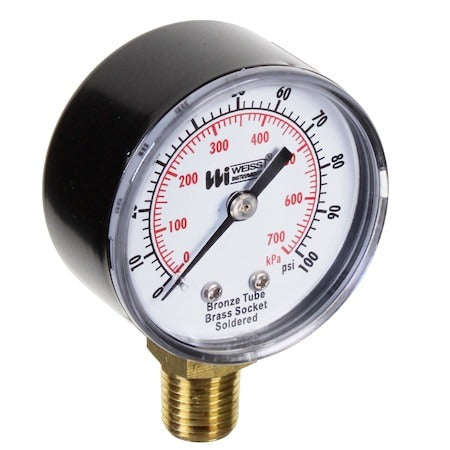

Weiss WEISS-TL15-100-8L Pressure Gauge 0-100 Psi

Availability:
In Stock
Ships same day if ordered by 12 pm
- $49.34
- $49.34
- Unit price
- / per
✓
Better Price in Cart
Manufacturer pricing rules prevent us from advertising our discount — no account or email required to see it.
-
Secure Payments
-
Easy Returns
-
Expert Advice
-
Fast Shipping
Product Description
The Weiss WEISS-TL15-100-8L is a dual scale pressure gauge rated from 0 to 100 psi, designed for use in HVAC and pneumatic system applications. It features a 1.5-inch drawn steel dial case finished in black with a push-in polycarbonate window. The wetted materials are brass and bronze, making it compatible with standard refrigerant-side and air-side pressure monitoring tasks. Accuracy is plus or minus 2 percent of full scale, which meets typical field-verification requirements. The lower 1/8-inch NPT male connection allows direct installation into manifold ports, test tees, or system taps without additional adapters in most configurations. Licensed HVAC technicians and pipefitters are the primary installers of this gauge.
This gauge is suited for residential and light commercial HVAC systems, as well as pneumatic control circuits where a compact, bottom-connected pressure indicator is needed. Its operating temperature range of -40 degrees F to 140 degrees F covers most mechanical room and rooftop installation environments. The dual scale display presents readings in both psi and kPa, which is useful on jobs requiring SI-unit documentation or equipment with metric labeling. The Series TL15 platform is a standard format widely stocked for quick field replacement of worn or damaged gauges.
Key Features
- Dual scale display: 0-100 psi and kPa equivalent readings on a single dial
- Plus or minus 2 percent full-scale accuracy for reliable field pressure readings
- 1/8-inch NPT male lower connection for direct port installation
- Drawn steel case with black finish and push-in polycarbonate window
- Wetted parts in brass and bronze for compatibility with common HVAC and pneumatic media
- Operating range from -40 degrees F to 140 degrees F covers most field conditions
Compatibility
Designed as an OEM-style replacement or new-installation gauge for HVAC and pneumatic systems requiring a 1/8-inch NPT male lower-connection pressure gauge in the 0-100 psi range.
Installation Notes
Installation is performed by licensed HVAC technicians or pipefitters. Isolate and depressurize the system completely before removing an existing gauge or installing this unit. Apply thread sealant tape to the NPT threads per standard trade practice and tighten with an appropriately sized wrench — do not overtighten into plastic or soft-metal manifold bodies. Verify the system is within the gauge operating temperature range before returning to service.
Technical Specifications

Complete your install
We pulled together the parts most installs need for this unit, plus a few add-ons worth a look. Check what you need — nothing here blocks checkout.
Loading install accessories...
Add install kit to cart
—
Related Products
- Choosing a selection results in a full page refresh.