


Search
-
HVAC Equipment
-
Ductless Mini Splits
- Ductless Mini Splits
- Shop By Zone
- Shop by BTU
- Shop By Brand
- Components
- Accessories
-
HVAC Parts & Supplies
- HVAC Parts & Supplies
- HVAC Supplies
- HVAC Tools
-
HVAC Replacement Parts
- Blower Housing & Assemblies
- Blower Wheels
- Breakers, Contactors & Disconnects
- Capacitors & Transformers
- Control & Circuit Boards
- Filter Driers & Accumulators
- Gas Valves & Conversion Kits
- Heat Exchangers
- Thermal Expansion Valves (TXV)
- Temperature Controls
- Wall Brackets & Parts
- Miscellaneous Parts
- O-Rings & Gaskets
- Hydronics
- Motors
- Thermostats & Zoning
-
Plumbing
-
Pool
-
Electrical
-
Air Quality
-
Tools & Supplies
-
Door Security & Hardware


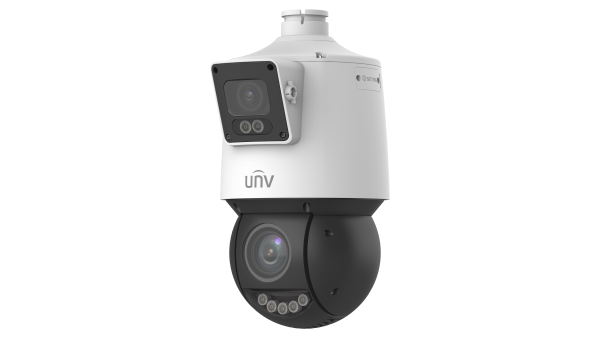
Uniview ipc94144sfw-x25-f40c Dual-channel Ptz Camera 25X
Availability:
Out Of Stock
- $779.91
- $779.91
- Unit price
- / per
✓
Better Price in Cart
Manufacturer pricing rules prevent us from advertising our discount — no account or email required to see it.

Secure Payments
-
Easy Returns
-
Expert Advice
-
Fast Shipping
Product Description
The UNIVIEW ipc94144sfw-x25-f40c is a dual-channel MultiView PTZ network camera that integrates a fixed panoramic sensor and a 25X optical zoom PTZ sensor into a single unit operating on one IP address. Channel 1 delivers a wide-angle panoramic view through a 4MP, 1/1.8-inch CMOS sensor with a 4.0 mm fixed lens and a 94.9-degree horizontal field of view. Channel 2 provides a detailed close-up view through a 1/2.7-inch CMOS sensor with a 4.8 to 120 mm varifocal lens and 25X optical zoom. Both channels share a 120 dB WDR rating and support IR-cut filter auto-switching. LightHunter technology enables color imaging down to 0.0005 Lux on Channel 1. Licensed security installers and network camera technicians are the primary installers of this unit.
This camera is suited for wide-area surveillance applications in commercial and public spaces where simultaneous panoramic coverage and detailed subject tracking are required. Channel 2 PTZ can be linked to Channel 1 smart intrusion prevention rules, allowing the PTZ to automatically track objects that trigger a cross-line, intrusion, enter-area, or leave-area detection event. People counting and crowd density monitoring functions make it applicable for retail, transit, and venue environments. The unit supports both IR and warm light illumination to handle low-light and full-color nighttime scenarios. Power is supplied via DC 12V or PoE+ (IEEE 802.3at).
Key Features
- Dual-channel integration: fixed panoramic lens plus 25X optical zoom PTZ on a single IP address
- LightHunter technology with Channel 1 minimum illumination of 0.0005 Lux (F1.0, AGC ON)
- 120 dB WDR on both channels for high-contrast scene handling
- Smart intrusion prevention with PTZ auto-tracking linked to fixed-channel detection rules
- People counting and crowd density monitoring for retail, transit, and public venue deployments
- Supports sound and light warning output; Alarm I/O 2 in / 1 out, Audio I/O 1 in / 1 out
- Compression support: Ultra 265, H.265, H.264, MJPEG
Compatibility
Designed for integration into IP video surveillance systems supporting Ultra 265, H.265, H.264, or MJPEG streams with PoE+ (IEEE 802.3at) infrastructure or DC 12V power supply.
Installation Notes
This camera should be installed by a licensed security or low-voltage technician familiar with IP network camera commissioning. Confirm the PoE+ switch or injector meets IEEE 802.3at power requirements before connecting. Power down the network port and any local DC supply before making wiring connections to the alarm and audio terminals. Follow local low-voltage and data cabling codes applicable to the installation jurisdiction.
Technical Specifications

Complete your install
We pulled together the parts most installs need for this unit, plus a few add-ons worth a look. Check what you need — nothing here blocks checkout.
Loading install accessories...
Add install kit to cart
—
Related Products
- Choosing a selection results in a full page refresh.