


Search
-
HVAC Equipment
-
Ductless Mini Splits
- Ductless Mini Splits
- Shop By Zone
- Shop by BTU
- Shop By Brand
- Components
- Accessories
-
HVAC Parts & Supplies
- HVAC Parts & Supplies
- HVAC Supplies
- HVAC Tools
-
HVAC Replacement Parts
- Blower Housing & Assemblies
- Blower Wheels
- Breakers, Contactors & Disconnects
- Capacitors & Transformers
- Control & Circuit Boards
- Filter Driers & Accumulators
- Gas Valves & Conversion Kits
- Heat Exchangers
- Thermal Expansion Valves (TXV)
- Temperature Controls
- Wall Brackets & Parts
- Miscellaneous Parts
- O-Rings & Gaskets
- Hydronics
- Motors
- Thermostats & Zoning
-
Plumbing
-
Pool
-
Electrical
-
Air Quality
-
Tools & Supplies
-
Door Security & Hardware


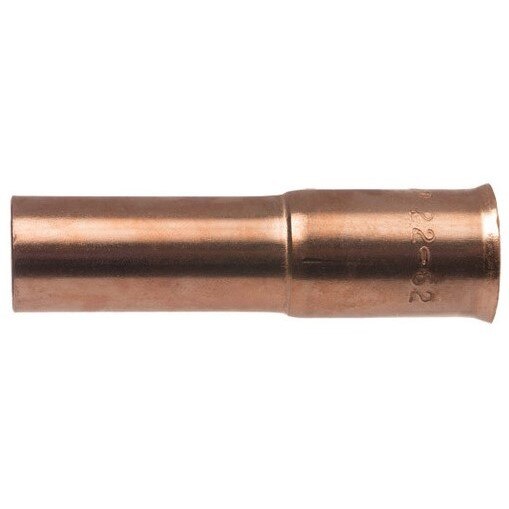

Tweco 1220-1110 Mig Welding Nozzle 1/2 in Bore 250A
Ships in 4 - 5 Weeks
- $28.76
- $28.76
- Unit price
- / per
✓
Better Price in Cart
Manufacturer pricing rules prevent us from advertising our discount — no account or email required to see it.

Secure Payments
-
Easy Returns
-
Expert Advice
-
Fast Shipping
Product Description
The TWECO 1220-1110 is a copper MIG welding nozzle designed for use with Tweco No. 2 MIG guns rated up to 250 amps. Manufactured from 122 DHP copper alloy tubing that is cut and formed to shape, it provides reliable heat resistance suited for light to medium duty welding applications. The nozzle features a 0.5-inch bore and measures 2.1 inches in length with a 0.75-inch outer diameter. An adjustable recess-to-protruding contact tip relationship lets the technician dial in the precise tip-to-nozzle geometry required for the weld joint at hand. The part number is roll-stamped on the outer surface for fast identification in the field.
This nozzle is intended for light to medium duty MIG welding applications drawing up to 250 amps. The adjustable tip relationship supports three common configurations. Recessed tip setups suit higher heat applications requiring longer electrical stick-out or situations where the nozzle may contact the work piece, such as tack, spot, and stitch welds. Flush tip setups work where a shorter electrical stick-out and tighter arc length are preferred. Protruding tip setups are used when welding open root pipe or tight weld joints where reach into the joint is necessary. This nozzle is compatible with the standard Tweco nozzle insulator and standard gas diffuser for the No. 2 gun series. Sold as 2 per pack.
Key Features
- 122 DHP copper alloy construction for effective heat dissipation in higher heat weld scenarios
- Adjustable recess-to-protruding contact tip relationship for flexible weld joint geometry
- Slides over the standard Tweco nozzle insulator without modification
- Part number roll-stamped on outer surface for quick identification
- Nozzle housing cut and formed from copper alloy tubing for consistent bore geometry
- Sold as a 2-piece pack to reduce downtime during nozzle changes
Compatibility
Designed for use with Tweco No. 2 MIG guns rated up to 250 amps using a standard gas diffuser and standard nozzle insulator.
Installation Notes
Installation is performed by qualified welding technicians or MIG gun service personnel. Always power down and de-energize the welding system before changing front-end consumables. Slide the nozzle over the nozzle insulator and adjust the contact tip position to achieve the desired recess, flush, or protruding relationship before resuming welding operations. Inspect the nozzle seating and insulator condition at each change to prevent arcing damage to front-end components.
Technical Specifications

Complete your install
We pulled together the parts most installs need for this unit, plus a few add-ons worth a look. Check what you need — nothing here blocks checkout.
Loading install accessories...
Add install kit to cart
—
Related Products
- Choosing a selection results in a full page refresh.