


Search
-
HVAC Equipment
-
Ductless Mini Splits
- Ductless Mini Splits
- Shop By Zone
- Shop by BTU
- Shop By Brand
- Components
- Accessories
-
HVAC Parts & Supplies
- HVAC Parts & Supplies
- HVAC Supplies
- HVAC Tools
-
HVAC Replacement Parts
- Blower Housing & Assemblies
- Blower Wheels
- Breakers, Contactors & Disconnects
- Capacitors & Transformers
- Control & Circuit Boards
- Filter Driers & Accumulators
- Gas Valves & Conversion Kits
- Heat Exchangers
- Thermal Expansion Valves (TXV)
- Temperature Controls
- Wall Brackets & Parts
- Miscellaneous Parts
- O-Rings & Gaskets
- Hydronics
- Motors
- Thermostats & Zoning
-
Plumbing
-
Pool
-
Electrical
-
Air Quality
-
Tools & Supplies
-
Door Security & Hardware


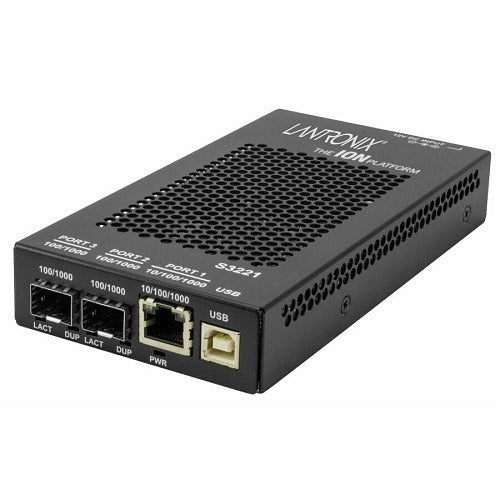

Transition Networks S3221-1040-T-AR Dual Sfp Media Converter
Availability:
Out Of Stock
- $2,650.38
- $2,650.38
- Unit price
- / per
✓
Better Price in Cart
Manufacturer pricing rules prevent us from advertising our discount — no account or email required to see it.

Secure Payments
-
Easy Returns
-
Expert Advice
-
Fast Shipping
Product Description
The TRANSITION NETWORKS S3221-1040-T-AR is a media converter that bridges 10/100/1000BASE-T copper Ethernet to two SFP fiber uplink ports. It is designed for enterprise network environments where copper-to-fiber conversion is required at the edge or distribution layer. Network technicians and low-voltage installers deploy this device to extend network reach beyond the 328-foot copper limitation or to interconnect equipment across fiber backbone segments. The dual SFP port design adds flexibility for redundant uplinks or multi-fiber path configurations within a managed network infrastructure.
This converter is suited for enterprise LAN deployments where copper-to-fiber media conversion is needed at access or distribution points. Typical installations include data centers, campus networks, and commercial building structured cabling systems. It supports gigabit speeds on the copper side, making it compatible with standard 1000BASE-T switch ports and endpoints. The dual SFP slots accept industry-standard small form-factor pluggable transceivers, giving installers the option to select the appropriate fiber type and wavelength for the specific run.
Key Features
- 10/100/1000BASE-T copper port supports auto-negotiation across standard gigabit infrastructure
- Dual SFP slots allow selection of fiber type and wavelength per installation requirement
- Supports copper-to-fiber conversion for extending network distances beyond copper limits
- Enterprise-class device suitable for structured cabling and data center edge deployments
- Compact single-unit form factor sold individually
Compatibility
Designed as an OEM-style media converter for enterprise network environments requiring 10/100/1000BASE-T copper to dual SFP fiber conversion. Compatible SFP transceivers are not included and must be sourced separately based on fiber type and link distance requirements.
Installation Notes
Installation should be performed by a qualified low-voltage network technician familiar with structured cabling standards and fiber handling procedures. Power down or disconnect the host network segment before connecting or removing SFP transceivers to avoid electrostatic damage to the optical interfaces. Follow TIA-568 and applicable local codes for cabling and equipment rack placement. Do not bend fiber patch cables beyond the minimum bend radius specified by the cable manufacturer.
Technical Specifications

Complete your install
We pulled together the parts most installs need for this unit, plus a few add-ons worth a look. Check what you need — nothing here blocks checkout.
Loading install accessories...
Add install kit to cart
—
Related Products
- Choosing a selection results in a full page refresh.