


Search
-
HVAC Equipment
-
Ductless Mini Splits
- Ductless Mini Splits
- Shop By Zone
- Shop by BTU
- Shop By Brand
- Components
- Accessories
-
HVAC Parts & Supplies
- HVAC Parts & Supplies
- HVAC Supplies
- HVAC Tools
-
HVAC Replacement Parts
- Blower Housing & Assemblies
- Blower Wheels
- Breakers, Contactors & Disconnects
- Capacitors & Transformers
- Control & Circuit Boards
- Filter Driers & Accumulators
- Gas Valves & Conversion Kits
- Heat Exchangers
- Thermal Expansion Valves (TXV)
- Temperature Controls
- Wall Brackets & Parts
- Miscellaneous Parts
- O-Rings & Gaskets
- Hydronics
- Motors
- Thermostats & Zoning
-
Plumbing
-
Pool
-
Electrical
-
Air Quality
-
Tools & Supplies
-
Door Security & Hardware


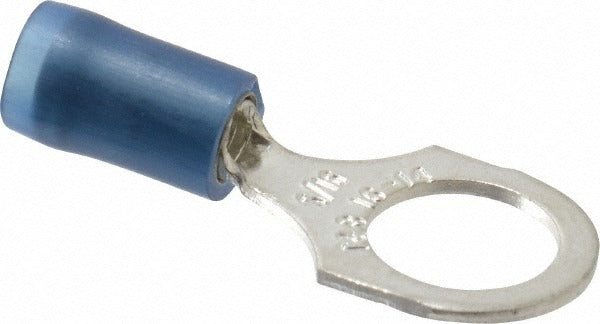
Thomas Betts RB14-516 Ring Terminal 18-14 Awg 5/16 Stud 100pk
Availability:
In Stock

Ships same day if ordered by 12 pm
- $141.78
- $141.78
- Unit price
- / per
✓
Better Price in Cart
Manufacturer pricing rules prevent us from advertising our discount — no account or email required to see it.
-
Secure Payments
-
Easy Returns
-
Expert Advice
-
Fast Shipping
Product Description
The THOMAS BETTS RB14-516 is a partially insulated, D-shaped ring terminal designed for crimp connections on 18 to 14 AWG copper conductors. The terminal features a copper contact with TiN (titanium nitride) plating for reliable conductivity and corrosion resistance. The nylon insulation sleeve is blue-coded for fast visual identification of the compatible wire gauge range. At 1.08 inches long and 0.47 inches wide, the RB14-516 accepts a 5/16 inch stud and is engineered for secure, high-cycle terminations in panel wiring, control circuits, and general electrical assembly work. Electricians and assembly technicians install these terminals using a ratchet crimp tool sized for the AWG range.
This ring terminal is suited for residential, commercial, and industrial electrical installations where a permanent, vibration-resistant ring lug termination is required. Typical applications include control panel wiring, HVAC low-voltage circuits, motor terminations, and equipment grounding connections. The partially insulated design allows the ring barrel to seat flush against a stud or lug without insulation interference. Sold in a package quantity of 100, the RB14-516 is appropriate for service contractors and panel shops that terminate wire in volume.
Key Features
- Crimp connection type rated for 18 to 14 AWG wire
- 5/16 inch stud size accommodates common terminal block and equipment stud dimensions
- Copper contact with TiN plating for conductivity and corrosion resistance
- Nylon partial insulation sleeve, blue color-coded for 18 to 14 AWG identification
- Meets UL 486A, UL 486B, CSA 22.2, and RoHS compliance requirements
- Package quantity of 100 per unit for shop and field use
Compatibility
Designed as an OEM-style crimp ring terminal for use with 18 to 14 AWG stranded or solid copper conductors terminating on a 5/16 inch stud.
Installation Notes
Installation is performed by licensed electricians or qualified technicians in accordance with NEC guidelines for terminal connections. Always de-energize the circuit and verify zero voltage before installing or removing ring terminals. Use a calibrated ratchet crimp tool rated for the wire gauge and terminal series to ensure a proper crimp that meets UL pull-force requirements. Do not solder over a crimped connection, as this can create a stress point and compromise long-term joint integrity.
Technical Specifications

Complete your install
We pulled together the parts most installs need for this unit, plus a few add-ons worth a look. Check what you need — nothing here blocks checkout.
Loading install accessories...
Add install kit to cart
—
Related Products
- Choosing a selection results in a full page refresh.