


Search
-
HVAC Equipment
-
Ductless Mini Splits
- Ductless Mini Splits
- Shop By Zone
- Shop by BTU
- Shop By Brand
- Components
- Accessories
-
HVAC Parts & Supplies
- HVAC Parts & Supplies
- HVAC Supplies
- HVAC Tools
-
HVAC Replacement Parts
- Blower Housing & Assemblies
- Blower Wheels
- Breakers, Contactors & Disconnects
- Capacitors & Transformers
- Control & Circuit Boards
- Filter Driers & Accumulators
- Gas Valves & Conversion Kits
- Heat Exchangers
- Thermal Expansion Valves (TXV)
- Temperature Controls
- Wall Brackets & Parts
- Miscellaneous Parts
- O-Rings & Gaskets
- Hydronics
- Motors
- Thermostats & Zoning
-
Plumbing
-
Pool
-
Electrical
-
Air Quality
-
Tools & Supplies
-
Door Security & Hardware


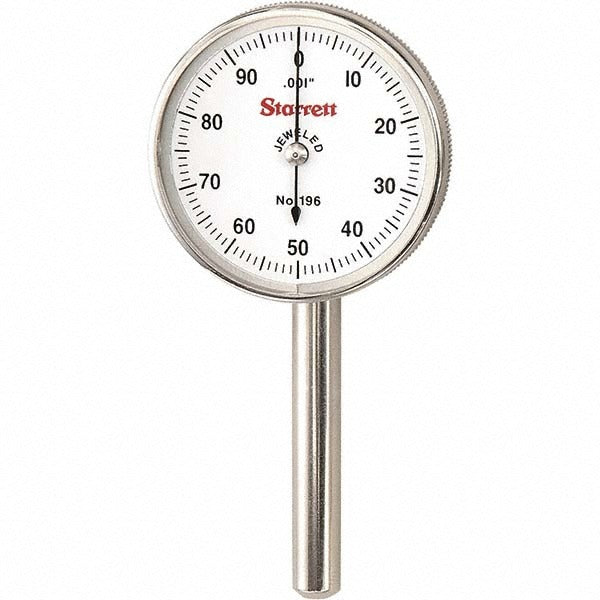
Starrett 66865 Dial Drop Indicator 0-0.2in 0.001in Grad
Availability:
In Stock

Ships same day if ordered by 12 pm
- $301.42
- $301.42
- Unit price
- / per
✓
Better Price in Cart
Manufacturer pricing rules prevent us from advertising our discount — no account or email required to see it.
-
Secure Payments
-
Easy Returns
-
Expert Advice
-
Fast Shipping
Product Description
The STARRETT 66865 is a plunger-style dial drop indicator designed for precise linear measurement in inspection, setup, and alignment work. It covers a measurement range of 0 to 0.2 inches with a dial graduation of 0.001 inches, giving technicians and machinists reliable resolution for surface variation, runout, and positional checks. The 1-7/16 inch (1.4375 inches) white dial face with a 0-100 dial reading makes it easy to read in shop and field conditions. The 0.25-inch stem diameter fits standard magnetic base and indicator holders commonly used across machining, fabrication, and mechanical service environments. A NIST traceability certification is included, supporting quality documentation requirements.
The STARRETT 66865 suits dimensional inspection tasks in manufacturing, mechanical assembly, and precision maintenance applications. Its plunger-back configuration positions it for drop indicator setups where vertical plunger contact is required, such as checking flatness, squareness, or part height consistency on surface plates or machine beds. With an overall length of approximately 3.05 inches, it fits in tight indicator setups without interference. Machinists, toolmakers, and precision maintenance technicians working in metalworking and industrial service environments are the primary users.
Key Features
- Measurement range of 0 to 0.2 inches with 0.001-inch graduation for fine linear resolution
- Plunger-back indicator style for vertical drop measurement setups
- 1-7/16 inch white dial face with 0-100 reading for clear at-a-glance use
- 0.25-inch stem diameter fits standard indicator holders and magnetic bases
- NIST traceability certification included for quality and calibration records
- Rugged construction with smooth, consistent plunger operation
Compatibility
Designed as a plunger-style drop indicator compatible with standard 0.25-inch stem diameter indicator holders, magnetic bases, and surface gauge arms used in general precision measurement setups.
Installation Notes
A licensed machinist or precision inspection technician typically mounts this indicator using a magnetic base or indicator stand with a compatible stem clamp. Ensure the mounting arm is rigid and the plunger contacts the workpiece at a perpendicular angle to minimize cosine error. Zero the dial after securing the indicator in position before taking readings. Keep the plunger free of chips, coolant buildup, and debris to maintain smooth and accurate operation.
Technical Specifications

Complete your install
We pulled together the parts most installs need for this unit, plus a few add-ons worth a look. Check what you need — nothing here blocks checkout.
Loading install accessories...
Add install kit to cart
—
Related Products
- Choosing a selection results in a full page refresh.