


Search
-
HVAC Equipment
-
Ductless Mini Splits
- Ductless Mini Splits
- Shop By Zone
- Shop by BTU
- Shop By Brand
- Components
- Accessories
-
HVAC Parts & Supplies
- HVAC Parts & Supplies
- HVAC Supplies
- HVAC Tools
-
HVAC Replacement Parts
- Blower Housing & Assemblies
- Blower Wheels
- Breakers, Contactors & Disconnects
- Capacitors & Transformers
- Control & Circuit Boards
- Filter Driers & Accumulators
- Gas Valves & Conversion Kits
- Heat Exchangers
- Thermal Expansion Valves (TXV)
- Temperature Controls
- Wall Brackets & Parts
- Miscellaneous Parts
- O-Rings & Gaskets
- Hydronics
- Motors
- Thermostats & Zoning
-
Plumbing
-
Pool
-
Electrical
-
Air Quality
-
Tools & Supplies
-
Door Security & Hardware


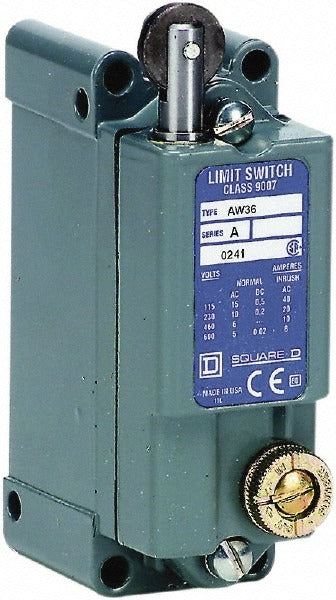
Square D 9007AW36 Limit Switch Spdt Nc Roller Plunger

Availability:
In Stock
Ships same day if ordered by 12 pm
- $337.86
- $337.86
- Unit price
- / per
✓
Better Price in Cart
Manufacturer pricing rules prevent us from advertising our discount — no account or email required to see it.
-
Secure Payments
-
Easy Returns
-
Expert Advice
-
Fast Shipping
Product Description
The SQUARE D 9007AW36 is a general purpose limit switch rated for up to 600 volts AC, designed to detect the presence, position, or movement of mechanical components in industrial and commercial control systems. It features a side-mounted roller plunger actuator with a screw terminal connection and a zinc body built for durable service. The switch operates on a single-pole double-throw (SPDT) contact form with a normally closed (NC) configuration, making it suitable for safety interlocks, conveyor systems, door controls, and machinery position sensing. Licensed electricians and industrial control technicians are the typical installers.
The 9007AW36 is suited for surface-mount installation in environments where ingress protection and temperature stability are required. It carries an IP65 ingress protection rating, keeping out dust and low-pressure water jets, and is rated for operating temperatures from 0 degrees F to 185 degrees F. NEMA ratings of 1, 2, 4, 12, and 13 make it appropriate for indoor and select outdoor industrial enclosures. It meets IEC 60529 standards and is RoHS compliant, fitting facilities that require restricted hazardous substance compliance.
Key Features
- SPDT contact form with normally closed (NC) configuration for safety interlock and position sensing applications
- Side-mounted roller plunger actuator, 1.44 inches in length, for reliable mechanical actuation
- 600 volt AC rating supports a wide range of industrial control circuit voltages
- IP65 ingress protection and NEMA 1, 2, 4, 12, 13 ratings for use in dusty or wet industrial environments
- Zinc body construction for durability in demanding service locations
- RoHS compliant and meets IEC 60529 standards
Compatibility
Designed as an OEM-style replacement or direct-install general purpose limit switch for industrial machinery, conveyor systems, and commercial control panel applications requiring a side roller plunger, surface-mount SPDT limit switch at up to 600 volts AC.
Installation Notes
Installation should be performed by a licensed electrician or qualified control systems technician in accordance with the National Electrical Code (NEC) and applicable local codes. De-energize and lock out the circuit before mounting or wiring the switch. Secure the switch to a flat surface using the appropriate fasteners for the mounting footprint, and connect field wiring to the screw terminals per the control circuit diagram. Verify actuator alignment and travel before restoring power to the system.
Technical Specifications

Complete your install
We pulled together the parts most installs need for this unit, plus a few add-ons worth a look. Check what you need — nothing here blocks checkout.
Loading install accessories...
Add install kit to cart
—
Related Products
- Choosing a selection results in a full page refresh.