


Search
-
HVAC Equipment
-
Ductless Mini Splits
- Ductless Mini Splits
- Shop By Zone
- Shop by BTU
- Shop By Brand
- Components
- Accessories
-
HVAC Parts & Supplies
- HVAC Parts & Supplies
- HVAC Supplies
- HVAC Tools
-
HVAC Replacement Parts
- Blower Housing & Assemblies
- Blower Wheels
- Breakers, Contactors & Disconnects
- Capacitors & Transformers
- Control & Circuit Boards
- Filter Driers & Accumulators
- Gas Valves & Conversion Kits
- Heat Exchangers
- Thermal Expansion Valves (TXV)
- Temperature Controls
- Wall Brackets & Parts
- Miscellaneous Parts
- O-Rings & Gaskets
- Hydronics
- Motors
- Thermostats & Zoning
-
Plumbing
-
Pool
-
Electrical
-
Air Quality
-
Tools & Supplies
-
Door Security & Hardware


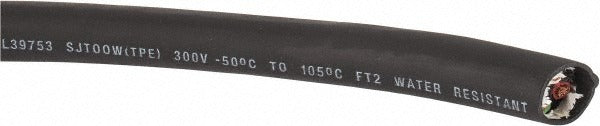
Southwire 55046504 12/4 Sjeoow Replacement Cord 20A 300V

Availability:
In Stock
Ships same day if ordered by 12 pm
- $595.53
- $595.53
- Unit price
- / per
✓
Better Price in Cart
Manufacturer pricing rules prevent us from advertising our discount — no account or email required to see it.
-
Secure Payments
-
Easy Returns
-
Expert Advice
-
Fast Shipping
Product Description
The SOUTHWIRE 55046504 is a 12/4 SJEOOW-type replacement cord rated for 20 amps and 300 volts, designed for demanding indoor and outdoor electrical service applications. This four-conductor, 12 AWG cord carries a black jacket and is built to handle the physical and environmental stresses common in commercial, industrial, and heavy-duty trade settings. It meets UL 62, CSA, MSHA, and NEC Article 400 standards, making it appropriate for use in classified and general-purpose environments. Licensed electricians and facilities maintenance professionals use this cord for replacement wiring on tools, equipment drops, and portable power applications where a durable, flexible conductor is required.
This cord is suited for both indoor and outdoor installations where a flexible, oil-resistant, and weather-resistant replacement cord is needed. Its SJEOOW designation indicates a junior hard-service cord with thermoplastic elastomer insulation and jacket, making it appropriate for environments with exposure to moisture, oils, and temperature variation. Typical applications include equipment power leads, portable tool cords, and industrial drop cords in commercial and light industrial settings. The 250-foot coil is sold in minimum 125-foot cut increments, allowing job-specific lengths to be ordered without excess waste.
Key Features
- SJEOOW-type construction with oil- and moisture-resistant thermoplastic elastomer jacket
- 12 AWG with 4 conductors rated at 20 amps and 300 volts
- Suitable for both indoor and outdoor environments
- Compliant with NEC Article 400, NEC Article 501.140 Class I Division 2, UL 62, CSA C22.2 No. 49, MSHA, and RoHS requirements
- Available in 125-foot minimum cut lengths from a 250-foot coil
- Black jacket for standard identification in replacement cord applications
Compatibility
Designed as a general-purpose SJEOOW replacement cord for use with tools, equipment, and portable power assemblies requiring a 12 AWG 4-conductor flexible cord rated at 20 amps and 300 volts in indoor or outdoor service conditions.
Installation Notes
Installation should be performed by a licensed electrician in accordance with NEC Article 400 and any applicable local codes. De-energize all circuits before terminating or splicing the cord. Verify that the connected load does not exceed the 20-amp current rating of the cord. Avoid sharp bends, pinch points, and contact with surfaces that could abrade the jacket during routing.
Technical Specifications

Complete your install
We pulled together the parts most installs need for this unit, plus a few add-ons worth a look. Check what you need — nothing here blocks checkout.
Loading install accessories...
Add install kit to cart
—
Related Products
- Choosing a selection results in a full page refresh.