


Search
-
HVAC Equipment
-
Ductless Mini Splits
- Ductless Mini Splits
- Shop By Zone
- Shop by BTU
- Shop By Brand
- Components
- Accessories
-
HVAC Parts & Supplies
- HVAC Parts & Supplies
- HVAC Supplies
- HVAC Tools
-
HVAC Replacement Parts
- Blower Housing & Assemblies
- Blower Wheels
- Breakers, Contactors & Disconnects
- Capacitors & Transformers
- Control & Circuit Boards
- Filter Driers & Accumulators
- Gas Valves & Conversion Kits
- Heat Exchangers
- Thermal Expansion Valves (TXV)
- Temperature Controls
- Wall Brackets & Parts
- Miscellaneous Parts
- O-Rings & Gaskets
- Hydronics
- Motors
- Thermostats & Zoning
-
Plumbing
-
Pool
-
Electrical
-
Air Quality
-
Tools & Supplies
-
Door Security & Hardware


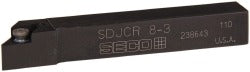
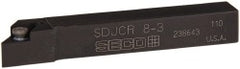
Seco 00071952 Sdjc Indexable Turning Toolholder
Availability:
In Stock

Ships same day if ordered by 12 pm
- $184.16
- $184.16
- Unit price
- / per
✓
Better Price in Cart
Manufacturer pricing rules prevent us from advertising our discount — no account or email required to see it.
-
Secure Payments
-
Easy Returns
-
Expert Advice
-
Fast Shipping
Product Description
The SECO 00071952 is a right-hand SDJC-style indexable turning toolholder designed for external turning operations on CNC and manual lathes. It features a neutral rake angle of 0 degrees and accepts DC..32.5. series inserts, specifically DCMT 32.52 geometry, secured by a screw-lock clamping method for positive insert retention. The shank measures 0.5 inches wide by 0.5 inches tall with an overall length of 3.5 inches. Constructed from steel, this toolholder delivers the rigidity and dimensional consistency required for precision turning across a wide range of workpiece materials. Licensed machinists and CNC setup technicians are the primary installers.
This toolholder is suited for turning applications in job shops, production machining cells, and maintenance environments where a compact 0.5-inch shank fits the tool block or turret station. The SDJC style with a negative 3-degree lead angle and right-hand cutting direction is commonly applied to straight and facing cuts on universal workpiece materials covering material codes H, K, M, N, P, and S. The back-of-bar to cutting edge dimension is 0.625 inches, which determines centerline offset when setting tool height. Both single-spindle and turret lathe setups are typical application environments.
Key Features
- SDJC toolholder style with right-hand cutting direction and neutral 0-degree rake angle
- Screw-lock insert holding method for secure, repeatable insert indexing
- Accepts DCMT 32.52 inserts with a 0.375-inch inscribed circle
- Compact 0.5 inches x 0.5 inches shank fits standard small-bore tool blocks and turret stations
- Steel construction for rigidity and long service life under interrupted and continuous cuts
- Universal material compatibility covering steel, stainless, cast iron, non-ferrous, high-temp alloys, and plastics
Compatibility
Designed to accept DC..32.5. series inserts; confirmed compatible insert designation is DCMT 32.52. Fits tool blocks and turret stations dimensioned for a 0.5-inch square shank. Catalog reference number SDJCR L83 applies to this holder style and shank size.
Installation Notes
Installation is performed by qualified machinists or CNC setup technicians. Power down and lock out the spindle drive before changing or indexing inserts. Verify tool centerline height against the lathe spindle centerline before taking the first cut. Use only the specified insert style and size to ensure proper seating and screw engagement; mixing incompatible insert geometries risks tool failure and workpiece damage.
Technical Specifications

Complete your install
We pulled together the parts most installs need for this unit, plus a few add-ons worth a look. Check what you need — nothing here blocks checkout.
Loading install accessories...
Add install kit to cart
—
Related Products
- Choosing a selection results in a full page refresh.