


Search
-
HVAC Equipment
-
Ductless Mini Splits
- Ductless Mini Splits
- Shop By Zone
- Shop by BTU
- Shop By Brand
- Components
- Accessories
-
HVAC Parts & Supplies
- HVAC Parts & Supplies
- HVAC Supplies
- HVAC Tools
-
HVAC Replacement Parts
- Blower Housing & Assemblies
- Blower Wheels
- Breakers, Contactors & Disconnects
- Capacitors & Transformers
- Control & Circuit Boards
- Filter Driers & Accumulators
- Gas Valves & Conversion Kits
- Heat Exchangers
- Thermal Expansion Valves (TXV)
- Temperature Controls
- Wall Brackets & Parts
- Miscellaneous Parts
- O-Rings & Gaskets
- Hydronics
- Motors
- Thermostats & Zoning
-
Plumbing
-
Pool
-
Electrical
-
Air Quality
-
Tools & Supplies
-
Door Security & Hardware


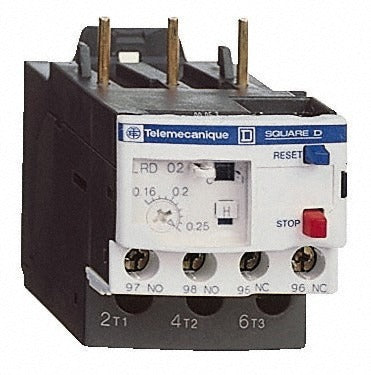
Schneider Electric LRD01 Thermal Iec Overload Relay

Availability:
Out Of Stock
- $94.88
- $94.88
- Unit price
- / per
✓
Better Price in Cart
Manufacturer pricing rules prevent us from advertising our discount — no account or email required to see it.
-
Secure Payments
-
Easy Returns
-
Expert Advice
-
Fast Shipping
Product Description
The SCHNEIDER ELECTRIC LRD01 is a thermal IEC overload relay rated for current settings from 0.1 to 0.16 amps at up to 690 VAC. It provides overcurrent protection for motor loads by tripping on sustained overload conditions using a bimetallic thermal sensing element. This relay carries a Trip Class 10A rating, meaning it is designed to trip within 10 seconds at six times the set current, which suits standard induction motor starting profiles. Licensed electricians and industrial controls technicians install this device as part of a motor starter assembly. Its compact form factor — 3.5 inches long, 3 inches wide, and 1.9 inches tall — makes it practical in tight control panel layouts.
The LRD01 is suited for light-duty motor protection applications where precise low-amperage overload detection is required. It is rated for use in assemblies operating at supply voltages up to 690 VAC, covering most single-phase and three-phase industrial and commercial control circuits in this current range. This relay is specifically compatible with LC1D09 and LC1D38 contactors, allowing direct mount without additional hardware. It is a common replacement component in motor control centers and panel-mounted starter assemblies across light manufacturing, HVAC fan motor circuits, and pump control panels.
Key Features
- Adjustable current range from 0.1 to 0.16 amps for precise overload protection at low motor currents
- Rated to 690 VAC, covering a wide range of single-phase and three-phase supply voltages
- Trip Class 10A rating suits standard induction motor starting characteristics
- Thermal sensing method provides reliable, time-delay overload detection
- Direct-mount compatibility with LC1D09 and LC1D38 contactors eliminates the need for adapter kits
- Compact dimensions of 3.5 x 3 x 1.9 inches fit standard DIN rail panel layouts
Compatibility
Designed for direct mounting to LC1D09 and LC1D38 IEC contactors. Consult the full LRD series selection guide for additional contactor compatibility within the TeSys D product family.
Installation Notes
A licensed electrician should install this overload relay in accordance with NFPA 70 (NEC) Article 430 covering motor branch-circuit and overload protection. De-energize and lock out the full control panel before mounting or replacing this relay. Verify that the relay current adjustment dial is set to match the full-load amperage of the protected motor before restoring power. Do not apply force to snap the relay onto the contactor until proper alignment is confirmed.
Technical Specifications

Complete your install
We pulled together the parts most installs need for this unit, plus a few add-ons worth a look. Check what you need — nothing here blocks checkout.
Loading install accessories...
Add install kit to cart
—
Related Products
- Choosing a selection results in a full page refresh.