


Search
-
HVAC Equipment
-
Ductless Mini Splits
- Ductless Mini Splits
- Shop By Zone
- Shop by BTU
- Shop By Brand
- Components
- Accessories
-
HVAC Parts & Supplies
- HVAC Parts & Supplies
- HVAC Supplies
- HVAC Tools
-
HVAC Replacement Parts
- Blower Housing & Assemblies
- Blower Wheels
- Breakers, Contactors & Disconnects
- Capacitors & Transformers
- Control & Circuit Boards
- Filter Driers & Accumulators
- Gas Valves & Conversion Kits
- Heat Exchangers
- Thermal Expansion Valves (TXV)
- Temperature Controls
- Wall Brackets & Parts
- Miscellaneous Parts
- O-Rings & Gaskets
- Hydronics
- Motors
- Thermostats & Zoning
-
Plumbing
-
Pool
-
Electrical
-
Air Quality
-
Tools & Supplies
-
Door Security & Hardware


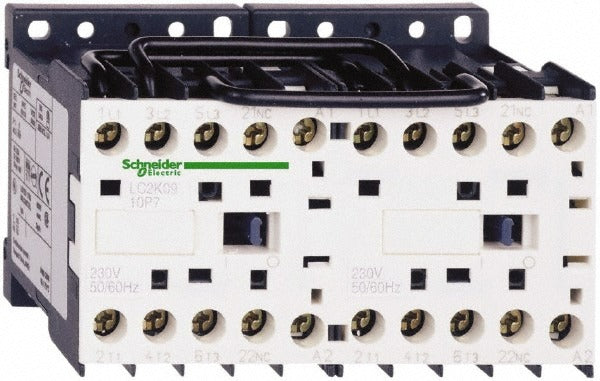
Schneider Electric LC2K1201B7 Iec Reversible Contactor 3P

Availability:
In Stock
Ships same day if ordered by 12 pm
- $272.92
- $272.92
- Unit price
- / per
✓
Better Price in Cart
Manufacturer pricing rules prevent us from advertising our discount — no account or email required to see it.
-
Secure Payments
-
Easy Returns
-
Expert Advice
-
Fast Shipping
Product Description
The SCHNEIDER ELECTRIC LC2K1201B7 is a 3-pole IEC reversible contactor designed for motor reversing control applications in industrial and commercial electrical systems. It operates on a 24 volt AC coil at 50/60 Hz and includes a normally closed (NC) auxiliary contact configuration. The reversible design allows a single unit to control forward and reverse motor direction, which is a core requirement in conveyor, pump, and machine-tool circuits. Licensed electricians and industrial maintenance technicians are the primary installers of this device. At 0.8 pounds, it is compact enough for panel mounting in tight enclosures while meeting multiple international standards including UL Listed and RoHS Compliant.
The LC2K1201B7 is suited for use in residential, commercial, and light industrial motor control panels where IEC-rated contactors are specified. It is a direct-fit solution for reversing starter assemblies, replacing worn or failed contactors in existing IEC control panels. The 24 volt AC coil makes it compatible with common low-voltage control circuits driven by standard control transformers. Its multi-standard certifications make it acceptable across a range of project specifications in North American and international installations.
Key Features
- 3-pole reversible configuration supports forward and reverse motor control in a single contactor
- 24 volt AC coil rated at 50/60 Hz for compatibility with standard low-voltage control circuits
- NC auxiliary contact included for interlocking and control logic integration
- Certified to UL Listed, CSA, IEC 60947, VDE 0660, BS 5424, NF C 63-110, and RoHS Compliant standards
- Compact body at 2.5 inches height, 3.6 inches width, and 2.3 inches depth for space-constrained panel installations
Compatibility
Designed as an OEM-style replacement IEC reversible contactor for use in motor control and reversing starter assemblies requiring a 3-pole, 24 volt AC coil device conforming to IEC 60947 ratings.
Installation Notes
Installation should be performed by a licensed electrician in accordance with NEC requirements and applicable local codes. De-energize and lockout/tagout all control and load-side power before removing or installing the contactor. Verify coil voltage and auxiliary contact configuration against the existing control schematic before wiring. In reversing applications, ensure proper electrical and mechanical interlocking is in place to prevent simultaneous energization of forward and reverse contactors.
Technical Specifications

Complete your install
We pulled together the parts most installs need for this unit, plus a few add-ons worth a look. Check what you need — nothing here blocks checkout.
Loading install accessories...
Add install kit to cart
—
Related Products
- Choosing a selection results in a full page refresh.