


Search
-
HVAC Equipment
-
Ductless Mini Splits
- Ductless Mini Splits
- Shop By Zone
- Shop by BTU
- Shop By Brand
- Components
- Accessories
-
HVAC Parts & Supplies
- HVAC Parts & Supplies
- HVAC Supplies
- HVAC Tools
-
HVAC Replacement Parts
- Blower Housing & Assemblies
- Blower Wheels
- Breakers, Contactors & Disconnects
- Capacitors & Transformers
- Control & Circuit Boards
- Filter Driers & Accumulators
- Gas Valves & Conversion Kits
- Heat Exchangers
- Thermal Expansion Valves (TXV)
- Temperature Controls
- Wall Brackets & Parts
- Miscellaneous Parts
- O-Rings & Gaskets
- Hydronics
- Motors
- Thermostats & Zoning
-
Plumbing
-
Pool
-
Electrical
-
Air Quality
-
Tools & Supplies
-
Door Security & Hardware


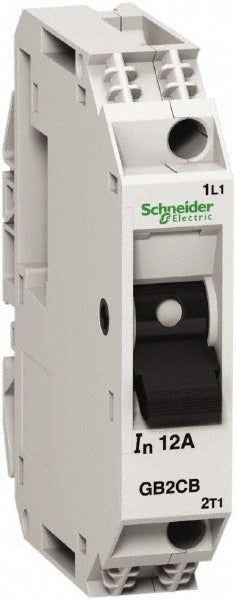

Schneider Electric GB2CB12 Circuit Protector 6A 1P

Availability:
In Stock
Ships same day if ordered by 12 pm
- $121.51
- $121.51
- Unit price
- / per
✓
Better Price in Cart
Manufacturer pricing rules prevent us from advertising our discount — no account or email required to see it.
-
Secure Payments
-
Easy Returns
-
Expert Advice
-
Fast Shipping
Product Description
The SCHNEIDER ELECTRIC GB2CB12 is a 6-amp, 1-pole circuit protector designed for DIN rail panel installations. It uses a thermal-magnetic trip mechanism to protect control circuits and equipment from overcurrent and short-circuit faults. The toggle switch reset actuator allows fast manual reset after a trip event without special tools. Mounting is accomplished via backplate clip onto standard DIN rail, keeping installation straightforward for panel builders and licensed electricians working in industrial control, HVAC control panels, and commercial electrical enclosures. Multiple breaking capacity ratings make this protector suitable across a range of fault-current environments.
This circuit protector fits residential and light commercial control panel applications where low-amperage branch circuit protection is required. It is commonly installed in HVAC control cabinets, motor control centers, and automation panel assemblies where a compact, single-pole protective device is needed on a DIN rail. The 1-pole, 6-amp rating suits low-voltage control circuits and small motor protection scenarios. Panel builders and electrical contractors typically select this device for replacement or new-build control panels requiring reliable overcurrent protection in a narrow form factor.
Key Features
- 6-amp, 1-pole rated for low-amperage branch and control circuit protection
- Thermal-magnetic trip mechanism provides both overload and short-circuit protection
- Toggle switch reset actuator allows manual reset without additional tools
- Backplate clip design mounts directly to standard DIN rail
- Multiple breaking capacity ratings accommodate varying fault-current environments
- Compact profile suitable for high-density panel layouts
Compatibility
Designed as an OEM-style replacement or new-installation circuit protector for standard DIN rail-equipped control panels and electrical enclosures requiring 1-pole, 6-amp thermal-magnetic protection.
Installation Notes
Installation should be performed by a qualified electrician or licensed panel builder in accordance with the National Electrical Code (NEC) and applicable local codes. De-energize the panel and verify the absence of voltage before mounting or wiring this device. Clip the unit onto the DIN rail using the integrated backplate clip and confirm it is fully seated before making load and line connections. Do not exceed the rated amperage or apply the device in circuits with fault-current levels beyond the rated breaking capacity.
Technical Specifications

Complete your install
We pulled together the parts most installs need for this unit, plus a few add-ons worth a look. Check what you need — nothing here blocks checkout.
Loading install accessories...
Add install kit to cart
—
Related Products
- Choosing a selection results in a full page refresh.