


Search
-
HVAC Equipment
-
Ductless Mini Splits
- Ductless Mini Splits
- Shop By Zone
- Shop by BTU
- Shop By Brand
- Components
- Accessories
-
HVAC Parts & Supplies
- HVAC Parts & Supplies
- HVAC Supplies
- HVAC Tools
-
HVAC Replacement Parts
- Blower Housing & Assemblies
- Blower Wheels
- Breakers, Contactors & Disconnects
- Capacitors & Transformers
- Control & Circuit Boards
- Filter Driers & Accumulators
- Gas Valves & Conversion Kits
- Heat Exchangers
- Thermal Expansion Valves (TXV)
- Temperature Controls
- Wall Brackets & Parts
- Miscellaneous Parts
- O-Rings & Gaskets
- Hydronics
- Motors
- Thermostats & Zoning
-
Plumbing
-
Pool
-
Electrical
-
Air Quality
-
Tools & Supplies
-
Door Security & Hardware


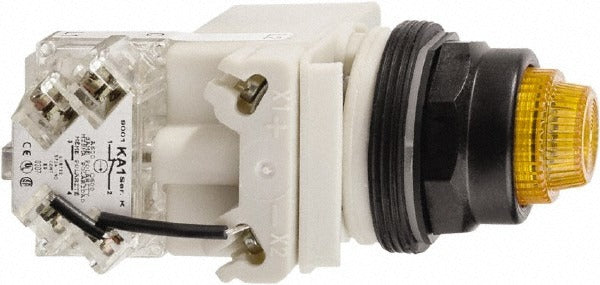
Schneider Electric 9001KT38LYA31 Led Indicating Light

Availability:
In Stock
Ships same day if ordered by 12 pm
- $330.85
- $330.85
- Unit price
- / per
✓
Better Price in Cart
Manufacturer pricing rules prevent us from advertising our discount — no account or email required to see it.
-
Secure Payments
-
Easy Returns
-
Expert Advice
-
Fast Shipping
Product Description
The SCHNEIDER ELECTRIC 9001KT38LYA31 is a 120-volt LED press-to-test indicating light designed for industrial and commercial control panel applications. It features an octagonal amber lens and a screw clamp connector, providing reliable visual status indication on machine control panels, switchgear, and automation equipment. The LED lamp type delivers long service life and low power consumption compared to incandescent alternatives. At 4.5 inches in length, 2.3 inches wide, and 2 inches tall, this unit fits standard panel cutouts and is built to meet a broad set of electrical safety and environmental standards. Electricians and controls technicians install this type of indicator as part of new panel builds or as a drop-in replacement for worn or failed units.
This indicating light is suited for residential, commercial, and industrial control panels where a clear visual signal is required. The amber lens color is commonly used to indicate a caution, standby, or process-active state. The press-to-test function allows technicians to verify lamp operation without energizing the circuit under test, which is a standard requirement during panel commissioning and routine maintenance. The screw clamp connector simplifies field wiring and supports solid or stranded conductors without additional ferrules in most installations.
Key Features
- 120-volt rated LED lamp for long-life, low-energy visual indication
- Amber octagonal lens for high-visibility status signaling
- Press-to-test function allows lamp verification without energizing the load circuit
- Screw clamp connector for fast, secure field wiring
- Meets NEMA 1, 2, 3, 3R, 4, 4X, 12, and 13 enclosure ratings
- RoHS compliant; listed to UL 508, CSA C22.2 No. 14, EN/IEC 60947-1, EN/IEC 60947-5-1, EN/IEC 60947-5-4, JIS C 4520, and JIS C 852
Compatibility
Designed as an OEM-style replacement or new-installation indicating light for industrial control panels and automation enclosures requiring a 120-volt LED pilot light with a standard panel-mount footprint.
Installation Notes
Installation should be performed by a licensed electrician in accordance with the NEC and any applicable local electrical codes. De-energize and lock out the panel before mounting or wiring the indicator. Confirm the supply voltage matches the 120-volt rating of this unit before making connections. The screw clamp connector should be tightened to the connector manufacturer's specification using a small flathead screwdriver; do not over-torque.
Technical Specifications

Complete your install
We pulled together the parts most installs need for this unit, plus a few add-ons worth a look. Check what you need — nothing here blocks checkout.
Loading install accessories...
Add install kit to cart
—
Related Products
- Choosing a selection results in a full page refresh.