


Search
-
HVAC Equipment
-
Ductless Mini Splits
- Ductless Mini Splits
- Shop By Zone
- Shop by BTU
- Shop By Brand
- Components
- Accessories
-
HVAC Parts & Supplies
- HVAC Parts & Supplies
- HVAC Supplies
- HVAC Tools
-
HVAC Replacement Parts
- Blower Housing & Assemblies
- Blower Wheels
- Breakers, Contactors & Disconnects
- Capacitors & Transformers
- Control & Circuit Boards
- Filter Driers & Accumulators
- Gas Valves & Conversion Kits
- Heat Exchangers
- Thermal Expansion Valves (TXV)
- Temperature Controls
- Wall Brackets & Parts
- Miscellaneous Parts
- O-Rings & Gaskets
- Hydronics
- Motors
- Thermostats & Zoning
-
Plumbing
-
Pool
-
Electrical
-
Air Quality
-
Tools & Supplies
-
Door Security & Hardware


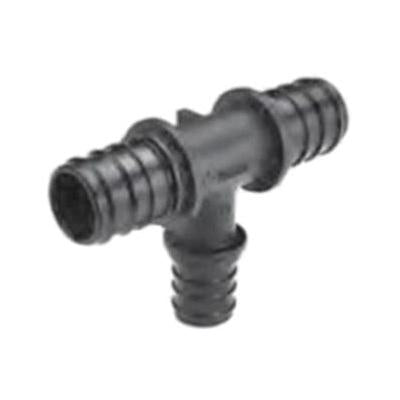
Rehau 104845-001 Branch Reducing Tee 1x1x3/4 in Everloc+

Availability:
In Stock
Ships same day if ordered by 12 pm
- $14.99
- $14.99
- Unit price
- / per
✓
Better Price in Cart
Manufacturer pricing rules prevent us from advertising our discount — no account or email required to see it.
-
Secure Payments
-
Easy Returns
-
Expert Advice
-
Fast Shipping
Product Description
The REHAU 104845-001 is a branch reducing tee fitting engineered for use in EVERLOC+ PEX-a piping systems. It connects two 1-inch run ports to a 3/4-inch branch port using EVERLOC+ cold expansion sleeve connections on all three ends. The fitting body is constructed from Acudel modified polyphenylsulfone, a high-performance thermoplastic suited for demanding plumbing applications. The overall length is 4 inches. This fitting is installed by licensed plumbers and mechanical contractors working on residential and commercial hydronic or domestic water distribution systems using RAUPEX PEX-a pipe. Installation requires EVERLOC+ compression sleeve tools and must follow published REHAU technical guidelines.
This tee is designed for branch takeoff scenarios where the main run remains at 1 inch and a reduced 3/4-inch branch feeds a sub-distribution leg or fixture group. Typical applications include domestic hot and cold water distribution, radiant heating supply and return manifolds, and potable water systems requiring lead-free fittings. All EVERLOC+ fittings comply with the lead-free requirements of the US Safe Drinking Water Act, and the system is rated in accordance with ASTM F877 and CSA B137.5 for SDR9 PEX pipe. Connection size 1 and connection size 2 are both 1 inch; connection size 3 (branch) is 3/4 inch.
Key Features
- Branch reducing tee configuration: 1 inch x 1 inch run with 3/4 inch branch outlet
- EVERLOC+ cold expansion sleeve connection type on all three ports for a secure, tool-driven joint
- Acudel modified polyphenylsulfone construction for high temperature and pressure resistance
- Compliant with ASTM F877 and CSA B137.5 for SDR9 PEX systems
- Lead-free construction meets US Safe Drinking Water Act requirements
- 4-inch overall length fits standard residential and light commercial rough-in layouts
Compatibility
Designed for use with RAUPEX PEX-a pipe in EVERLOC+ compression sleeve fitting systems. Installation requires EVERLOC+ compression sleeve tools. Maximum temperature and pressure ratings are in accordance with ASTM F877 and CSA B137.5 for SDR9 PEX; consult REHAU pipe product submittals for specific ratings.
Installation Notes
Installation must be performed by a licensed plumber using EVERLOC+ compression sleeve tools per published REHAU technical guidelines. Shut off and depressurize the water supply and relieve any residual system pressure before cutting into existing lines. Ensure pipe ends are cut square, deburred, and properly expanded before seating the fitting. All work should conform to applicable local plumbing codes and reference standards including ASTM F877 and CSA B137.5.
Technical Specifications

Complete your install
We pulled together the parts most installs need for this unit, plus a few add-ons worth a look. Check what you need — nothing here blocks checkout.
Loading install accessories...
Add install kit to cart
—
Related Products
- Choosing a selection results in a full page refresh.