


Search
-
HVAC Equipment
-
Ductless Mini Splits
- Ductless Mini Splits
- Shop By Zone
- Shop by BTU
- Shop By Brand
- Components
- Accessories
-
HVAC Parts & Supplies
- HVAC Parts & Supplies
- HVAC Supplies
- HVAC Tools
-
HVAC Replacement Parts
- Blower Housing & Assemblies
- Blower Wheels
- Breakers, Contactors & Disconnects
- Capacitors & Transformers
- Control & Circuit Boards
- Filter Driers & Accumulators
- Gas Valves & Conversion Kits
- Heat Exchangers
- Thermal Expansion Valves (TXV)
- Temperature Controls
- Wall Brackets & Parts
- Miscellaneous Parts
- O-Rings & Gaskets
- Hydronics
- Motors
- Thermostats & Zoning
-
Plumbing
-
Pool
-
Electrical
-
Air Quality
-
Tools & Supplies
-
Door Security & Hardware


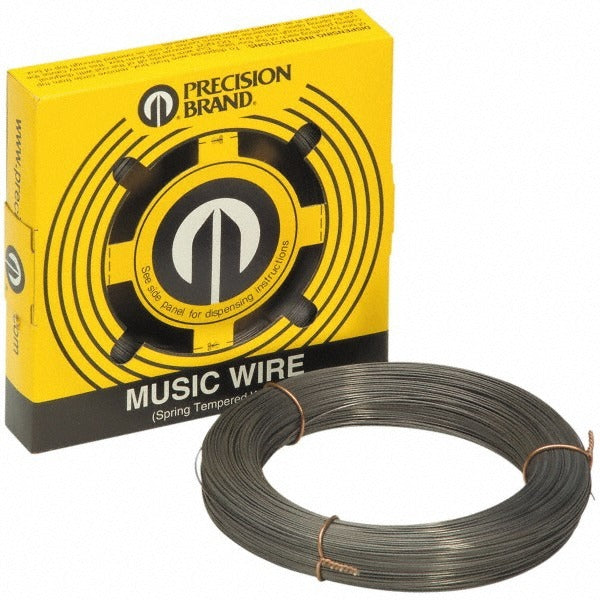
Precision Brand 21071 Music Wire Coil 28 Gauge 0.071 in 75 Ft
Availability:
In Stock

Ships same day if ordered by 12 pm
- $23.83
- $23.83
- Unit price
- / per
✓
Better Price in Cart
Manufacturer pricing rules prevent us from advertising our discount — no account or email required to see it.
-
Secure Payments
-
Easy Returns
-
Expert Advice
-
Fast Shipping
Product Description
The PRECISION BRAND 21071 is a tempered high carbon steel music wire coil conforming to ASTM A228, supplied in a 75-foot length at 0.071 inches in diameter — classified as 28 gauge. Tempered music wire delivers consistent tensile strength and elasticity, making it well suited for mechanical springs, safety wire applications, forming, and general fabrication tasks. The ASTM A228 designation confirms this wire meets established standards for chemical composition and mechanical properties. Technicians and fabricators working in HVAC, refrigeration, plumbing, or general mechanical trade will find this coil format convenient for field cuts and custom spring fabrication.
This wire coil is appropriate for light mechanical fabrication, spring forming, safety locking, and repair applications across residential and commercial service environments. It is commonly used where a controlled-diameter, high-tensile wire is needed for forming clips, retaining coils, or tension members in small mechanical assemblies. The 75-foot coil length provides enough stock for multiple cuts or formed components from a single spool. Tradespeople working in mechanical maintenance, HVAC service, or general facilities repair will find this gauge suited to fine-detail spring and wire work.
Key Features
- High carbon steel construction provides consistent tensile strength and elasticity for spring and forming applications
- Tempered finish ensures uniform hardness along the full coil length
- Meets ASTM A228 standard for composition and mechanical properties
- 0.071 inch diameter (28 gauge) for fine-detail mechanical wire work
- 75-foot coil length allows multiple cuts or formed components from a single piece
Compatibility
Designed as a general-purpose high carbon steel music wire coil suitable for mechanical spring fabrication, safety wire, and forming tasks in trade and light industrial applications where ASTM A228 compliant wire is required.
Installation Notes
Use appropriate wire cutters or flush-cut snips rated for high carbon steel to avoid damaging cutting edges. Wear cut-resistant gloves when handling or uncoiling, as tempered wire ends can be sharp. When forming springs or mechanical components, follow applicable mechanical or equipment service documentation for dimensional requirements. No heat should be applied to alter temper without controlled conditions, as field heating will reduce tensile properties.
Technical Specifications

Complete your install
We pulled together the parts most installs need for this unit, plus a few add-ons worth a look. Check what you need — nothing here blocks checkout.
Loading install accessories...
Add install kit to cart
—
Related Products
- Choosing a selection results in a full page refresh.