


Search
-
HVAC Equipment
-
Ductless Mini Splits
- Ductless Mini Splits
- Shop By Zone
- Shop by BTU
- Shop By Brand
- Components
- Accessories
-
HVAC Parts & Supplies
- HVAC Parts & Supplies
- HVAC Supplies
- HVAC Tools
-
HVAC Replacement Parts
- Blower Housing & Assemblies
- Blower Wheels
- Breakers, Contactors & Disconnects
- Capacitors & Transformers
- Control & Circuit Boards
- Filter Driers & Accumulators
- Gas Valves & Conversion Kits
- Heat Exchangers
- Thermal Expansion Valves (TXV)
- Temperature Controls
- Wall Brackets & Parts
- Miscellaneous Parts
- O-Rings & Gaskets
- Hydronics
- Motors
- Thermostats & Zoning
-
Plumbing
-
Pool
-
Electrical
-
Air Quality
-
Tools & Supplies
-
Door Security & Hardware


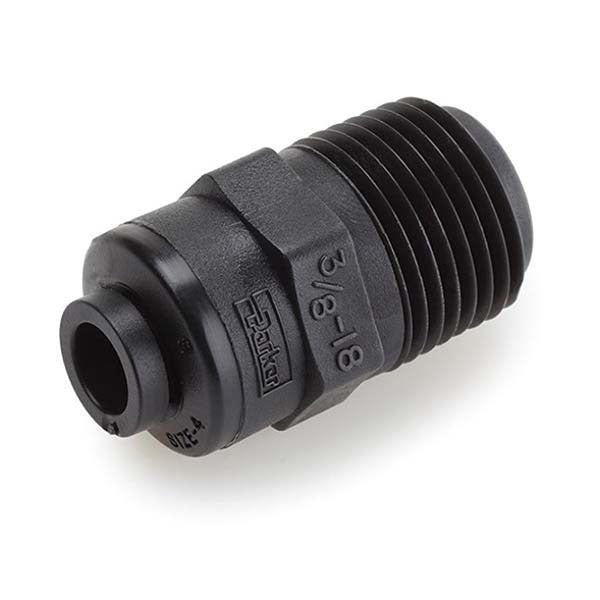
Parker FB6MC4-HBLK Push-to-connect Connector 3/8in Od
Availability:
In Stock

Ships same day if ordered by 12 pm
- $19.19
- $19.19
- Unit price
- / per
✓
Better Price in Cart
Manufacturer pricing rules prevent us from advertising our discount — no account or email required to see it.
-
Secure Payments
-
Easy Returns
-
Expert Advice
-
Fast Shipping
Product Description
The PARKER FB6MC4-HBLK is a push-to-connect tube-to-pipe connector fitting designed for fast, tool-free tube connections in plumbing, pneumatic, and fluid-handling systems. It accepts 3/8 inch OD tubing and connects to a 1/4 inch NPTF threaded port. The fitting body is constructed from Kynar, a highly chemical-resistant thermoplastic fluoropolymer well suited for corrosive media. The O-ring is FKM material, providing compatibility with a broad range of fluids and gases. Rated to 250 psi working pressure and a vacuum rating of 28 in-Hg, this connector is appropriate for both pressure and vacuum line work. Licensed plumbers, HVAC technicians, and industrial piping tradespeople are the primary installers.
This connector is used in residential and light commercial applications where quick-connect tube fittings are required at threaded pipe ports. Typical scenarios include chemical feed lines, water treatment equipment, pneumatic control tubing, and HVAC sensing or drain lines where a push-to-connect interface to an NPTF-threaded port is needed. The black color coding allows for easy visual identification in multi-line installations. The compact form factor makes it practical in tight panel and equipment enclosures.
Key Features
- Push-to-connect design allows fast, tool-free tube insertion for 3/8 inch OD tubing
- Kynar fluoropolymer body offers high chemical resistance for corrosive fluid and gas service
- FKM O-ring provides broad fluid compatibility including many hydrocarbons and chemicals
- Rated to 250 psi working pressure
- Vacuum rated to 28 in-Hg for vacuum line applications
- 1/4 inch NPTF male thread ensures a pressure-tight pipe connection without a separate sealant requirement
Compatibility
Designed as an OEM-style push-to-connect replacement connector for systems using 3/8 inch OD tubing with 1/4 inch NPTF threaded ports in plumbing, HVAC, and fluid-handling applications.
Installation Notes
Installation is performed by licensed plumbers, pipefitters, or HVAC technicians. Shut off system pressure and depressurize the line fully before removing or installing any fitting. Ensure the tube end is cut square and deburred before inserting into the push-to-connect collet; a ragged or angled cut will compromise the seal. NPTF threads are designed to seal on the thread form, but verify local code and application requirements before deciding whether thread sealant is also required.
Technical Specifications

Complete your install
We pulled together the parts most installs need for this unit, plus a few add-ons worth a look. Check what you need — nothing here blocks checkout.
Loading install accessories...
Add install kit to cart
—
Related Products
- Choosing a selection results in a full page refresh.