


Search
-
HVAC Equipment
-
Ductless Mini Splits
- Ductless Mini Splits
- Shop By Zone
- Shop by BTU
- Shop By Brand
- Components
- Accessories
-
HVAC Parts & Supplies
- HVAC Parts & Supplies
- HVAC Supplies
- HVAC Tools
-
HVAC Replacement Parts
- Blower Housing & Assemblies
- Blower Wheels
- Breakers, Contactors & Disconnects
- Capacitors & Transformers
- Control & Circuit Boards
- Filter Driers & Accumulators
- Gas Valves & Conversion Kits
- Heat Exchangers
- Thermal Expansion Valves (TXV)
- Temperature Controls
- Wall Brackets & Parts
- Miscellaneous Parts
- O-Rings & Gaskets
- Hydronics
- Motors
- Thermostats & Zoning
-
Plumbing
-
Pool
-
Electrical
-
Air Quality
-
Tools & Supplies
-
Door Security & Hardware


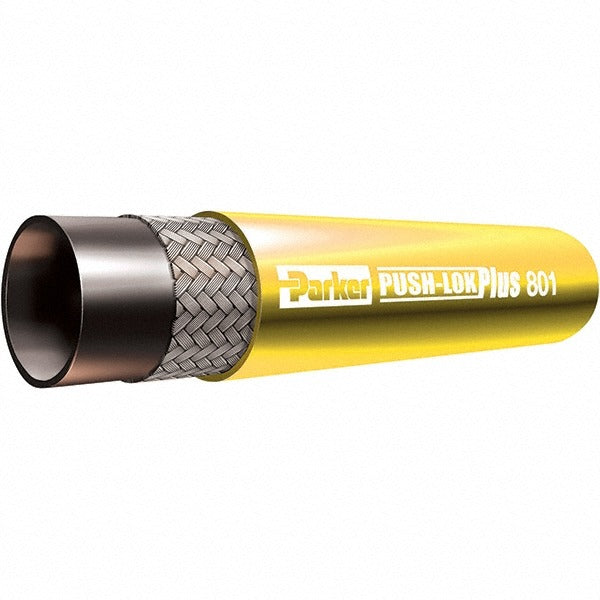
Parker 801-4-YEL-RL Push-on Air Hose 0.25 in Id Yellow
Availability:
In Stock

Ships same day if ordered by 12 pm
- $99.48
- $99.48
- Unit price
- / per
✓
Better Price in Cart
Manufacturer pricing rules prevent us from advertising our discount — no account or email required to see it.
-
Secure Payments
-
Easy Returns
-
Expert Advice
-
Fast Shipping
Product Description
The PARKER 801-4-YEL-RL is a push-on air hose designed for compressed air distribution in industrial, HVAC, and mechanical service environments. Constructed from yellow synthetic rubber, this hose features a 0.25 inch inside diameter and an outside diameter of 0.50 inches. It is rated for a working pressure of 350 psi and handles temperatures from -40 degrees F to 257 degrees F, making it suitable for both seasonal outdoor installations and high-heat indoor service areas. The hose ships cut-to-length from a 600-foot coil in 1-foot increments with a 25-foot minimum cut length. HVAC technicians, industrial mechanics, and plumbing contractors install this hose where a tool-free, push-on connection is required without crimped fittings.
This hose is suited for light-duty to medium-duty compressed air lines in residential and commercial HVAC systems, pneumatic tool supply runs, and general workshop or service-bay plumbing. The push-on design allows for fast, barbed-fitting connections without clamps or swaging equipment. The yellow jacket provides quick visual identification on job sites where multiple hose types are routed in the same area. It is appropriate for applications where the operating pressure stays within the 350 psi working rating and temperatures remain within the rated range.
Key Features
- Push-on design for fast, tool-free barbed-fitting connections without clamps or crimping equipment
- 350 psi working pressure rating suitable for standard compressed air service
- Wide temperature range of -40 degrees F to 257 degrees F supports both outdoor and high-heat indoor use
- Yellow synthetic rubber jacket for visual identification and chemical resistance
- 0.25 inch inside diameter with 0.50 inch outside diameter for consistent flow and easy routing
- Available cut-to-length in 1-foot increments from a 600-foot coil with 25-foot minimum order
Compatibility
Designed for use with standard push-on barbed fittings sized for 0.25 inch inside diameter air hose. No end connections are included; compatible fittings must be sourced separately to match the application.
Installation Notes
Installation is typically performed by licensed HVAC technicians, pipefitters, or industrial mechanics familiar with compressed air systems. Depressurize and lock out the air supply before cutting, connecting, or replacing any section of hose. Ensure the mating barbed fitting is fully seated to achieve a leak-free push-on connection. Verify that the system operating pressure and temperature do not exceed the hose ratings before returning the line to service.
Technical Specifications

Complete your install
We pulled together the parts most installs need for this unit, plus a few add-ons worth a look. Check what you need — nothing here blocks checkout.
Loading install accessories...
Add install kit to cart
—
Related Products
- Choosing a selection results in a full page refresh.