


Search
-
HVAC Equipment
-
Ductless Mini Splits
- Ductless Mini Splits
- Shop By Zone
- Shop by BTU
- Shop By Brand
- Components
- Accessories
-
HVAC Parts & Supplies
- HVAC Parts & Supplies
- HVAC Supplies
- HVAC Tools
-
HVAC Replacement Parts
- Blower Housing & Assemblies
- Blower Wheels
- Breakers, Contactors & Disconnects
- Capacitors & Transformers
- Control & Circuit Boards
- Filter Driers & Accumulators
- Gas Valves & Conversion Kits
- Heat Exchangers
- Thermal Expansion Valves (TXV)
- Temperature Controls
- Wall Brackets & Parts
- Miscellaneous Parts
- O-Rings & Gaskets
- Hydronics
- Motors
- Thermostats & Zoning
-
Plumbing
-
Pool
-
Electrical
-
Air Quality
-
Tools & Supplies
-
Door Security & Hardware


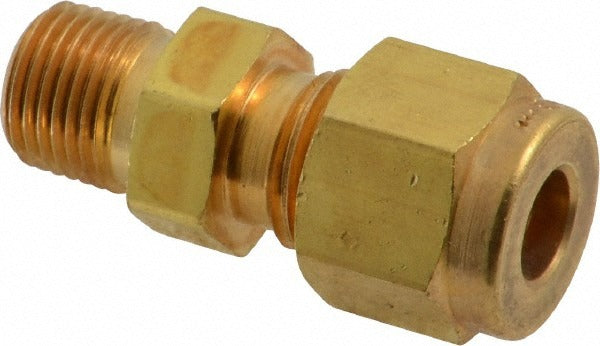

Parker 4-2 Fbz-b Compression Tube Connector 1/8 Inch Mnpt
Availability:
In Stock

Ships same day if ordered by 12 pm
- $19.14
- $19.14
- Unit price
- / per
✓
Better Price in Cart
Manufacturer pricing rules prevent us from advertising our discount — no account or email required to see it.
-
Secure Payments
-
Easy Returns
-
Expert Advice
-
Fast Shipping
Product Description
The PARKER 4-2 FBZ-B is a straight brass compression tube connector designed for joining tubing to a male NPT threaded port. It features a compression inlet on one end and a 1/8 inch MNPT threaded outlet on the other, creating a reliable, leak-resistant connection without soldering or flaring. Rated to 3500 psi maximum working pressure, this fitting is built to ASTM-B-453 and ASTM-B16 standards, making it suitable for high-pressure hydraulic, pneumatic, refrigeration, and instrumentation lines. Licensed HVAC technicians, plumbers, and instrumentation mechanics commonly install this fitting in control and sensing line applications.
This connector is used in residential and commercial settings wherever a compression tube must transition to an NPT threaded port. Typical applications include refrigerant sensing lines, hydraulic instrument tubing, pneumatic control circuits, and gas sampling lines. Its straight configuration keeps the connection compact and inline, which is useful in confined spaces or panel-mounted components. The 1.29 inch overall length keeps the fitting footprint small for tight installations.
Key Features
- 3500 psi maximum working pressure for demanding hydraulic and pneumatic service
- Compression x MNPT end connections eliminate soldering and flaring
- Straight fitting shape for direct inline tube-to-port connections
- Brass construction conforming to ASTM-B-453 and ASTM-B16 standards
- 1/8 inch MPT thread size compatible with standard NPT ported components
- Compact 1.29 inch overall length suits confined installation spaces
Compatibility
Designed as an OEM-style replacement or new-installation compression connector for systems requiring a 1/8 inch MNPT threaded port connection to compression tubing. Cross-reference Swagelok part number B-400-1-2 for direct substitution verification.
Installation Notes
Installation is typically performed by licensed HVAC technicians, plumbers, or instrumentation mechanics. Depressurize and isolate the line completely before removing or installing any compression fitting. Hand-tighten the compression nut onto the tube, then advance with a wrench per the fitting manufacturer's recommended turns — do not overtighten, as brass compression fittings can crack or deform the ferrule. Apply thread sealant compatible with the service fluid on the MNPT threads, and verify for leaks at operating pressure before returning the system to service.
WARNING: This product can expose you to chemicals including lead, which are known to the State of California to cause cancer and birth defects or other reproductive harm. For more information go to www.P65Warnings.ca.gov.
Technical Specifications

Complete your install
We pulled together the parts most installs need for this unit, plus a few add-ons worth a look. Check what you need — nothing here blocks checkout.
Loading install accessories...
Add install kit to cart
—
Related Products
- Choosing a selection results in a full page refresh.