


Search
-
HVAC Equipment
-
Ductless Mini Splits
- Ductless Mini Splits
- Shop By Zone
- Shop by BTU
- Shop By Brand
- Components
- Accessories
-
HVAC Parts & Supplies
- HVAC Parts & Supplies
- HVAC Supplies
- HVAC Tools
-
HVAC Replacement Parts
- Blower Housing & Assemblies
- Blower Wheels
- Breakers, Contactors & Disconnects
- Capacitors & Transformers
- Control & Circuit Boards
- Filter Driers & Accumulators
- Gas Valves & Conversion Kits
- Heat Exchangers
- Thermal Expansion Valves (TXV)
- Temperature Controls
- Wall Brackets & Parts
- Miscellaneous Parts
- O-Rings & Gaskets
- Hydronics
- Motors
- Thermostats & Zoning
-
Plumbing
-
Pool
-
Electrical
-
Air Quality
-
Tools & Supplies
-
Door Security & Hardware


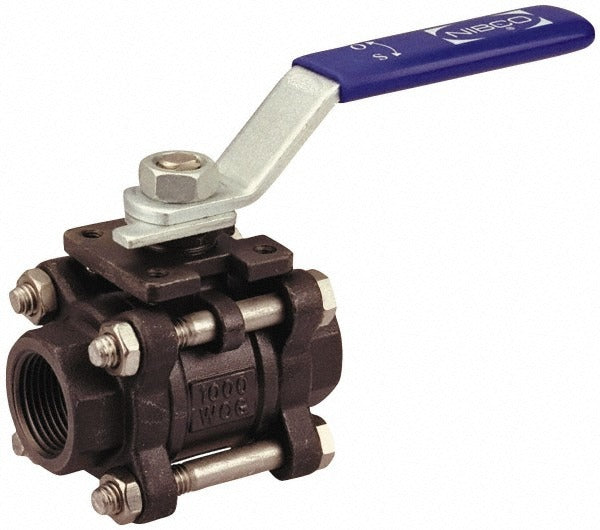
Nibco NL99J55 Ball Valve 3/8 in Full Port Fnpt Carbon Steel

Availability:
In Stock
Ships same day if ordered by 12 pm
- $125.85
- $125.85
- Unit price
- / per
✓
Better Price in Cart
Manufacturer pricing rules prevent us from advertising our discount — no account or email required to see it.
-
Secure Payments
-
Easy Returns
-
Expert Advice
-
Fast Shipping
Product Description
The NIBCO NL99J55 is a 3-piece, full-port manual ball valve designed for inline shutoff and flow control in commercial and industrial piping systems. Built with a carbon steel body and stainless steel trim, it handles demanding service conditions where corrosion resistance and mechanical strength are both required. The full-port design minimizes pressure drop across the valve. A locking lever handle prevents accidental operation and is suited for applications where tamper resistance or lockout/tagout procedures are in force. The seat material is reinforced polytetrafluoroethylene (PTFE), which provides reliable sealing across a wide range of fluid types. This valve is typically installed by licensed plumbers or pipefitters working on hydronic, compressed air, or general fluid service lines.
This valve is suited for residential and light commercial piping applications requiring a compact 3/8 inch full-port shutoff. The FNPT x FNPT end connections allow direct threaded installation into standard pipe runs without additional adapters. The 3-piece body construction allows the valve to be removed from the line for service or seat replacement without cutting the pipe. Typical installation scenarios include hydronic heating systems, compressed air distribution, and general-purpose liquid service lines where positive shutoff and occasional lockout capability are needed.
Key Features
- Full-port design minimizes flow restriction and pressure drop
- Carbon steel body provides high mechanical strength for demanding service environments
- Stainless steel trim resists corrosion in wet or chemically active service conditions
- Reinforced PTFE seats deliver durable, low-friction sealing across a broad range of fluids
- Locking lever handle supports lockout/tagout (LOTO) compliance and prevents accidental actuation
- 3-piece body construction allows in-line servicing without cutting the pipe
Compatibility
Designed as an OEM-style replacement or new-installation valve for 3/8 inch FNPT threaded pipe systems in residential and commercial plumbing, hydronic, and compressed air applications.
Installation Notes
Installation should be performed by a licensed plumber or pipefitter in accordance with applicable local codes and ASME B31 piping standards. Depressurize and drain the system fully before removing or installing any valve. Apply thread sealant or PTFE tape to male threads per standard practice, being careful not to over-apply material that could enter the valve body. Verify flow direction and handle orientation before final tightening.
Technical Specifications

Complete your install
We pulled together the parts most installs need for this unit, plus a few add-ons worth a look. Check what you need — nothing here blocks checkout.
Loading install accessories...
Add install kit to cart
—
Related Products
- Choosing a selection results in a full page refresh.