


Search
-
HVAC Equipment
-
Ductless Mini Splits
- Ductless Mini Splits
- Shop By Zone
- Shop by BTU
- Shop By Brand
- Components
- Accessories
-
HVAC Parts & Supplies
- HVAC Parts & Supplies
- HVAC Supplies
- HVAC Tools
-
HVAC Replacement Parts
- Blower Housing & Assemblies
- Blower Wheels
- Breakers, Contactors & Disconnects
- Capacitors & Transformers
- Control & Circuit Boards
- Filter Driers & Accumulators
- Gas Valves & Conversion Kits
- Heat Exchangers
- Thermal Expansion Valves (TXV)
- Temperature Controls
- Wall Brackets & Parts
- Miscellaneous Parts
- O-Rings & Gaskets
- Hydronics
- Motors
- Thermostats & Zoning
-
Plumbing
-
Pool
-
Electrical
-
Air Quality
-
Tools & Supplies
-
Door Security & Hardware


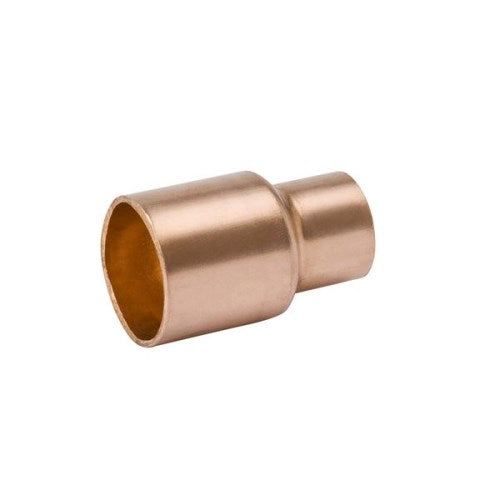

Ndl Industries W1083 Copper Reducing Coupling 2-5/8x2-1/8 Cxc

Availability:
In Stock
Ships same day if ordered by 12 pm
- $40.08
- $40.08
- Unit price
- / per
✓
Better Price in Cart
Manufacturer pricing rules prevent us from advertising our discount — no account or email required to see it.
-
Secure Payments
-
Easy Returns
-
Expert Advice
-
Fast Shipping
Product Description
The NDL INDUSTRIES W1083 is a copper reducing coupling designed to transition between two different pipe sizes in a sweat-connect (C x C) configuration. This fitting accepts a 2-5/8-inch connection on one end and a 2-1/8-inch connection on the other, allowing a plumber or HVAC technician to step down copper line sizes within a system. It is constructed for use in copper piping systems where a direct solder joint is required. The C x C ends are prepared for standard flux-and-solder installation following accepted trade practice. This fitting is sold in box quantities and is suited for both commercial and residential applications.
This reducing coupling is used wherever a copper piping system requires a size transition between 2-5/8-inch and 2-1/8-inch nominal outside-diameter tubing. Typical applications include HVAC refrigerant line sets, hydronic systems, and plumbing distribution mains where copper is the specified material. Licensed plumbers and HVAC technicians performing rough-in, retrofit, or repair work are the primary installers. The fitting is stocked in box quantities of 12, making it practical for contractors handling multiple connections on a single job.
Key Features
- Reduces from 2-5/8 inches to 2-1/8 inches in a single fitting
- C x C (sweat) connection type on both ends — compatible with standard flux-and-solder technique
- Copper construction for corrosion resistance and long service life in wet systems
- Box quantity of 12 units supports multi-connection jobsite needs
- Manufactured by NDL Industries Inc. to OEM-style dimensional standards
Compatibility
Designed as an OEM-style replacement or new-installation fitting for copper piping systems requiring a sweat-connect reduction from 2-5/8 inches to 2-1/8 inches outside diameter.
Installation Notes
Installation is performed by a licensed plumber or HVAC technician using standard copper sweat-joint tools including a tubing cutter, emery cloth or fitting brush, lead-free flux, and a propane or MAP-gas torch. Shut off and depressurize the system completely and ensure the pipe is dry before applying heat, as residual moisture will prevent a sound solder joint. Follow applicable local plumbing codes and ASTM B88 tubing standards when selecting compatible copper tube. Do not use open flame near combustible materials without proper shielding.
Technical Specifications

Complete your install
We pulled together the parts most installs need for this unit, plus a few add-ons worth a look. Check what you need — nothing here blocks checkout.
Loading install accessories...
Add install kit to cart
—
Related Products
- Choosing a selection results in a full page refresh.