


Search
-
HVAC Equipment
-
Ductless Mini Splits
- Ductless Mini Splits
- Shop By Zone
- Shop by BTU
- Shop By Brand
- Components
- Accessories
-
HVAC Parts & Supplies
- HVAC Parts & Supplies
- HVAC Supplies
- HVAC Tools
-
HVAC Replacement Parts
- Blower Housing & Assemblies
- Blower Wheels
- Breakers, Contactors & Disconnects
- Capacitors & Transformers
- Control & Circuit Boards
- Filter Driers & Accumulators
- Gas Valves & Conversion Kits
- Heat Exchangers
- Thermal Expansion Valves (TXV)
- Temperature Controls
- Wall Brackets & Parts
- Miscellaneous Parts
- O-Rings & Gaskets
- Hydronics
- Motors
- Thermostats & Zoning
-
Plumbing
-
Pool
-
Electrical
-
Air Quality
-
Tools & Supplies
-
Door Security & Hardware


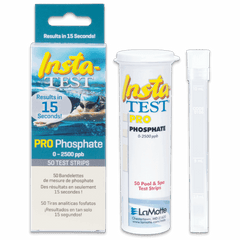
Lamotte 3021-h-6 Low Range Phosphate Test Strips 6 Pack
Availability:
Out Of Stock
- $24.29
- $24.29
- Unit price
- / per
✓
Better Price in Cart
Manufacturer pricing rules prevent us from advertising our discount — no account or email required to see it.

Secure Payments
-
Easy Returns
-
Expert Advice
-
Fast Shipping
Product Description
The LAMOTTE 3021-h-6 is a low-range phosphate test strip designed for water quality testing in pool and aquatic service applications. Each strip uses a reagent-delivery format to measure dissolved phosphate concentrations at seven discrete levels: 0, 100, 200, 300, 500, 1000, and 2500 parts per billion (ppb). Results are delivered in 15 seconds, making these strips a fast, field-ready diagnostic tool. Each bottle contains 50 strips, and this SKU ships as a 6-pack case of 300 strips total. Pool service technicians and water treatment professionals use these strips to identify phosphate loading that can feed algae growth and reduce sanitizer efficiency.
These test strips are suited for routine phosphate monitoring in residential and commercial pool service, as well as water feature and fountain maintenance. The low-range scale from 0 to 2500 ppb makes them appropriate for detecting phosphate levels commonly found after algaecide treatments, fill water additions, or organic contamination events. The rapid 15-second read time supports efficient on-site testing without the need for liquid reagent kits or colorimeters at initial screening.
Key Features
- Reagent-delivery strip format delivers results in 15 seconds
- Low-range scale: 0, 100, 200, 300, 500, 1000, and 2500 ppb phosphate
- 50 strips per bottle for convenient field use
- 6-pack case provides 300 total test strips per order
- No liquid reagents or additional equipment required for initial screening
Compatibility
Designed for use in pool, spa, and water feature applications where low-range phosphate monitoring is required. Suitable for any water chemistry testing program that tracks phosphate as part of algae prevention or water balance maintenance.
Installation Notes
These test strips are used by pool service professionals and water treatment technicians during routine water quality checks. No chemical handling certification is required to use test strips, but follow all applicable safety data sheet guidance when handling pool water samples. Store strips in their original sealed bottle away from direct sunlight, heat, and moisture to preserve reagent integrity. Do not use strips from a bottle that has been left open or exposed to humidity for extended periods, as reagent degradation will produce inaccurate readings.
Technical Specifications

Complete your install
We pulled together the parts most installs need for this unit, plus a few add-ons worth a look. Check what you need — nothing here blocks checkout.
Loading install accessories...
Add install kit to cart
—
Related Products
- Choosing a selection results in a full page refresh.