


Search
-
HVAC Equipment
-
Ductless Mini Splits
- Ductless Mini Splits
- Shop By Zone
- Shop by BTU
- Shop By Brand
- Components
- Accessories
-
HVAC Parts & Supplies
- HVAC Parts & Supplies
- HVAC Supplies
- HVAC Tools
-
HVAC Replacement Parts
- Blower Housing & Assemblies
- Blower Wheels
- Breakers, Contactors & Disconnects
- Capacitors & Transformers
- Control & Circuit Boards
- Filter Driers & Accumulators
- Gas Valves & Conversion Kits
- Heat Exchangers
- Thermal Expansion Valves (TXV)
- Temperature Controls
- Wall Brackets & Parts
- Miscellaneous Parts
- O-Rings & Gaskets
- Hydronics
- Motors
- Thermostats & Zoning
-
Plumbing
-
Pool
-
Electrical
-
Air Quality
-
Tools & Supplies
-
Door Security & Hardware


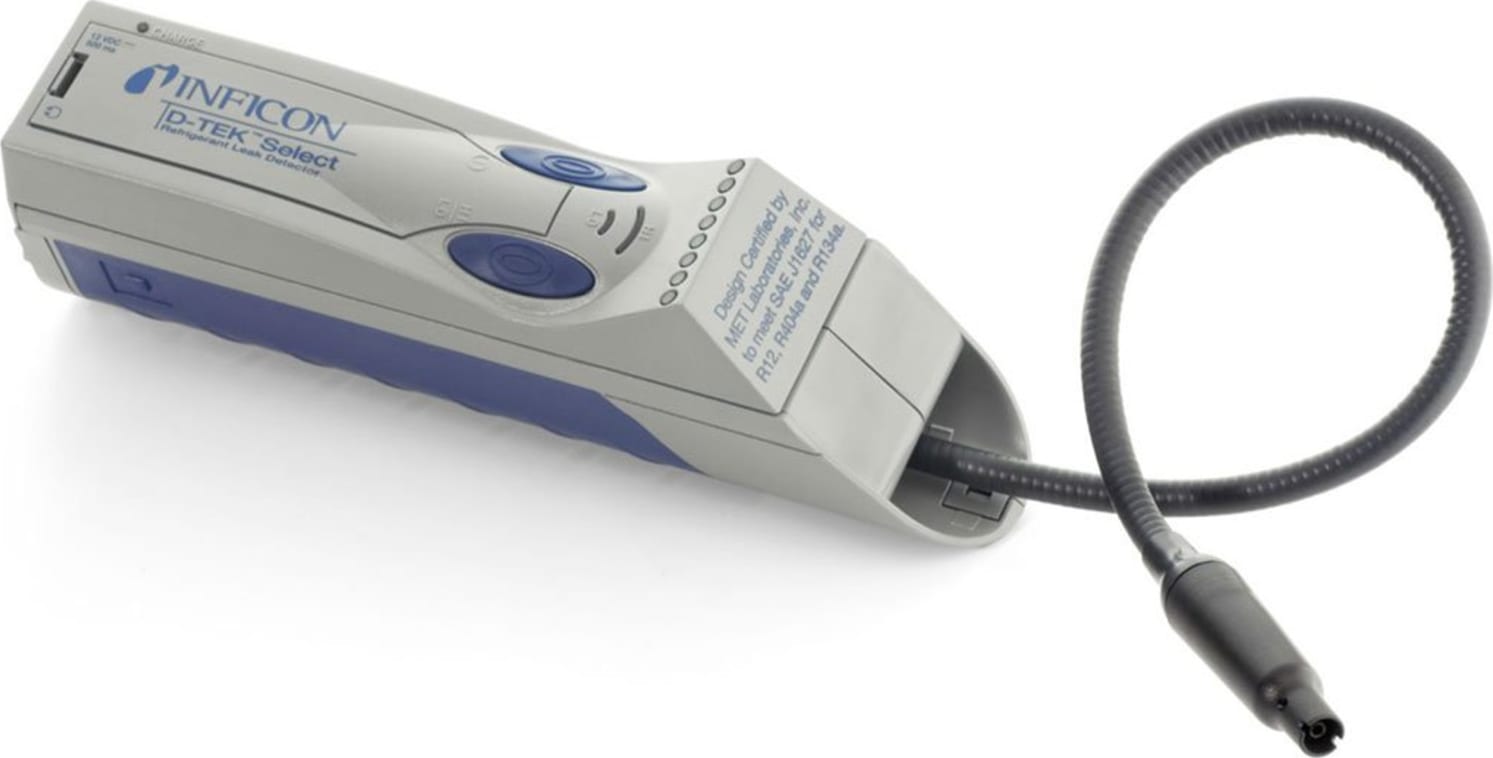


Inficon IN-712-202-G1 D-tek Select Refrigerant Leak Detector

Availability:
Out Of Stock
- $576.24
- $576.24
- Unit price
- / per
✓
Better Price in Cart
Manufacturer pricing rules prevent us from advertising our discount — no account or email required to see it.
-
Secure Payments
-
Easy Returns
-
Expert Advice
-
Fast Shipping
Product Description
The INFICON IN-712-202-G1 D-TEK Select is a cordless refrigerant leak detector built around an infrared absorption sensing cell that responds to all refrigerant types, including newer blends, while ignoring non-refrigerant gases. The sensing cell is rated for approximately 1,000 hours of service life, nearly ten times longer than earlier-generation heated-diode sensors. Power comes from a rechargeable nickel metal hydride (NiMH) battery pack. The unit includes a charging status indicator and a sensor failure indication light so technicians know the detector is operating within spec before and during a leak search. Licensed HVAC technicians performing system commissioning, service calls, or pre-inspection work will find this detector suited to both residential and light commercial applications.
The IN-712-202-G1 is intended for use by HVAC service professionals working on split systems, packaged units, chillers, refrigeration equipment, and any application where refrigerant containment must be verified. The infrared sensing technology makes it effective with HFCs, HCFCs, CFCs, and blended refrigerants that are common in current equipment. It is well suited for tight-space leak searches around coils, fittings, service valves, and line-set connections where a cordless, handheld form factor is necessary.
Key Features
- Infrared absorption sensing cell detects all refrigerant types, including newer blends
- Sensing cell rated for approximately 1,000 hours of service life
- Cordless design with rechargeable NiMH battery pack for unrestricted movement on the job site
- Charging status indicator confirms battery state before use
- Sensor failure indication alerts technician when the sensing cell is no longer performing within specification
- Selective infrared technology minimizes false positives from non-refrigerant gases
Compatibility
Designed for use with HFC, HCFC, CFC, and blended refrigerant systems typical in residential and light commercial HVAC and refrigeration equipment.
Installation Notes
Refrigerant leak detectors are serviced and operated by licensed HVAC technicians in accordance with EPA Section 608 regulations. Recover system refrigerant charge to an approved recovery cylinder before major repairs; use the detector to confirm successful evacuation or to locate leaks prior to recharge. Allow the detector to warm up fully per the manufacturer procedure before beginning a sweep to ensure accurate readings. Do not expose the sensing cell to high concentrations of refrigerant for extended periods, as this can shorten sensor life.
Technical Specifications

Complete your install
We pulled together the parts most installs need for this unit, plus a few add-ons worth a look. Check what you need — nothing here blocks checkout.
Loading install accessories...
Add install kit to cart
—
Related Products
- Choosing a selection results in a full page refresh.