


Search
-
HVAC Equipment
-
Ductless Mini Splits
- Ductless Mini Splits
- Shop By Zone
- Shop by BTU
- Shop By Brand
- Components
- Accessories
-
HVAC Parts & Supplies
- HVAC Parts & Supplies
- HVAC Supplies
- HVAC Tools
-
HVAC Replacement Parts
- Blower Housing & Assemblies
- Blower Wheels
- Breakers, Contactors & Disconnects
- Capacitors & Transformers
- Control & Circuit Boards
- Filter Driers & Accumulators
- Gas Valves & Conversion Kits
- Heat Exchangers
- Thermal Expansion Valves (TXV)
- Temperature Controls
- Wall Brackets & Parts
- Miscellaneous Parts
- O-Rings & Gaskets
- Hydronics
- Motors
- Thermostats & Zoning
-
Plumbing
-
Pool
-
Electrical
-
Air Quality
-
Tools & Supplies
-
Door Security & Hardware


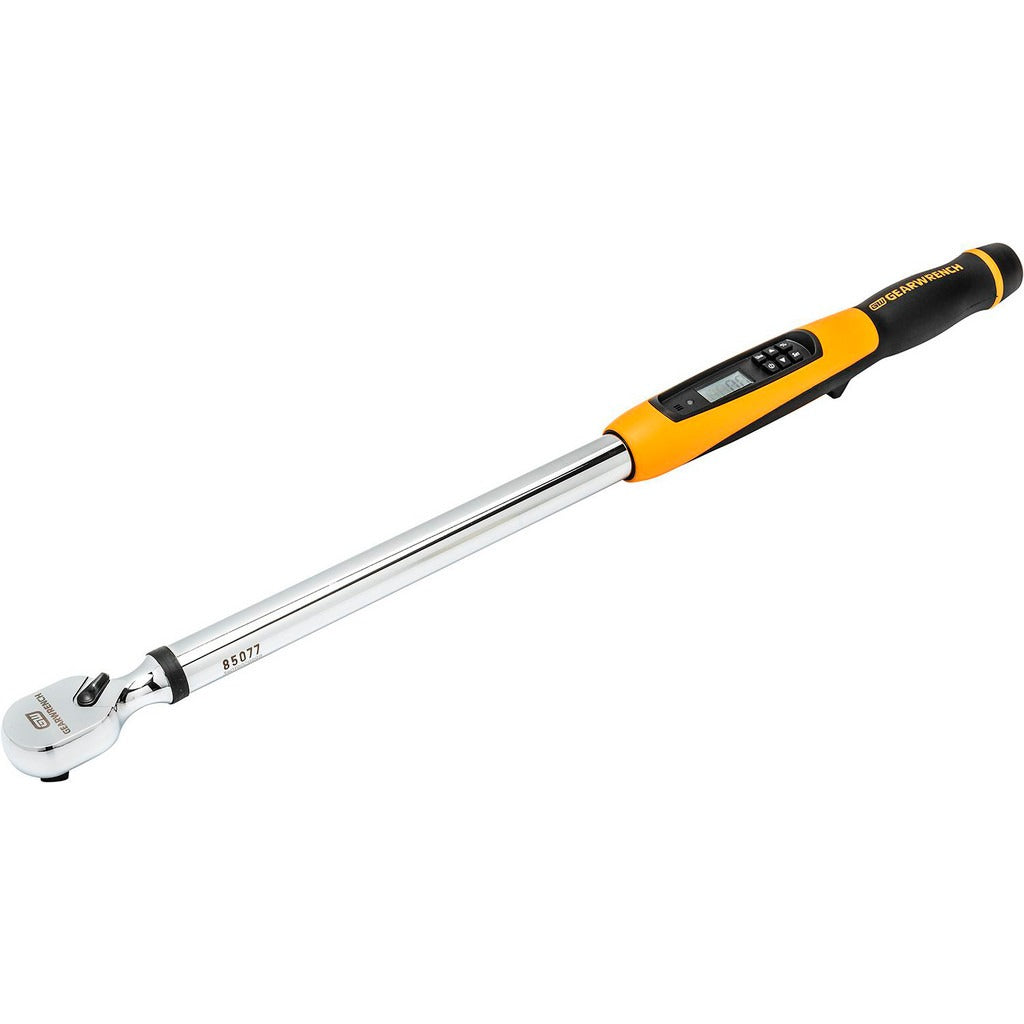
Gearwrench 85077 Electronic Torque Wrench 25.1-250.8 Ft/lb
Availability:
In Stock

Ships same day if ordered by 12 pm
- $253.44
- $253.44
- Unit price
- / per
✓
Better Price in Cart
Manufacturer pricing rules prevent us from advertising our discount — no account or email required to see it.
-
Secure Payments
-
Easy Returns
-
Expert Advice
-
Fast Shipping
Product Description
The GEARWRENCH 85077 is an electronic torque wrench built for professional technicians who need precise, repeatable torque application across a wide range of fastener work. It operates on a 1/2 inch square drive and covers a torque range of 25.1 to 250.8 ft/lb (20.3 to 142.4 Nm). The ratcheting head swings in both clockwise and counterclockwise directions, with clockwise accuracy rated at 2 percent and counterclockwise at 3 percent per ASME B107.28M. At 24.62 inches overall length and 5.2 pounds, it fits standard ratchet-wrench workflows without the bulk of a beam-style torque tool. A target torque alert signals when the set value is reached, reducing the risk of overtorque on critical fasteners.
This wrench is suited for automotive, fleet, heavy equipment, and industrial maintenance applications where calibrated torque documentation is required. It supports five torque measurement units — foot pound, inch pound, kilogram force centimeter, kilogram force meter, and Newton meter — making it practical for technicians who work across domestic and metric fastener specifications. The 72-tooth gear count allows a minimum arc swing of 5 degrees, which is useful in confined engine bays or tight mechanical assemblies. Licensed mechanics, diesel technicians, and industrial maintenance trades are the primary users.
Key Features
- Torque range: 25.1 to 250.8 ft/lb (20.3 to 142.4 Nm) with 2 percent clockwise accuracy
- Five selectable torque measurement units: ft/lb, in/lb, kgf/cm, kgf/m, and Nm
- 72-tooth ratchet head with 5-degree minimum arc swing for tight-space access
- Bidirectional ratchet — clockwise and counterclockwise rotation supported
- Audible and/or visual target torque alert prevents overtorque on critical fasteners
- Calibration certified to ASME B107.28M standard
- Steel body construction for durability in shop environments
Compatibility
Designed for use with standard 1/2 inch square drive sockets and accessories. Compatible with any 1/2 inch drive socket set used in automotive, fleet, or industrial maintenance applications.
Installation Notes
This tool is serviced and operated by licensed mechanics, diesel technicians, and industrial maintenance professionals. Before use, confirm the wrench has a current calibration certificate and is set to zero before storage. Do not use impact sockets or extensions that exceed the rated capacity of the drive. Store the wrench at its minimum torque setting to preserve the internal mechanism and maintain calibration integrity.
Technical Specifications

Complete your install
We pulled together the parts most installs need for this unit, plus a few add-ons worth a look. Check what you need — nothing here blocks checkout.
Loading install accessories...
Add install kit to cart
—
Related Products
- Choosing a selection results in a full page refresh.