


Search
-
HVAC Equipment
-
Ductless Mini Splits
- Ductless Mini Splits
- Shop By Zone
- Shop by BTU
- Shop By Brand
- Components
- Accessories
-
HVAC Parts & Supplies
- HVAC Parts & Supplies
- HVAC Supplies
- HVAC Tools
-
HVAC Replacement Parts
- Blower Housing & Assemblies
- Blower Wheels
- Breakers, Contactors & Disconnects
- Capacitors & Transformers
- Control & Circuit Boards
- Filter Driers & Accumulators
- Gas Valves & Conversion Kits
- Heat Exchangers
- Thermal Expansion Valves (TXV)
- Temperature Controls
- Wall Brackets & Parts
- Miscellaneous Parts
- O-Rings & Gaskets
- Hydronics
- Motors
- Thermostats & Zoning
-
Plumbing
-
Pool
-
Electrical
-
Air Quality
-
Tools & Supplies
-
Door Security & Hardware


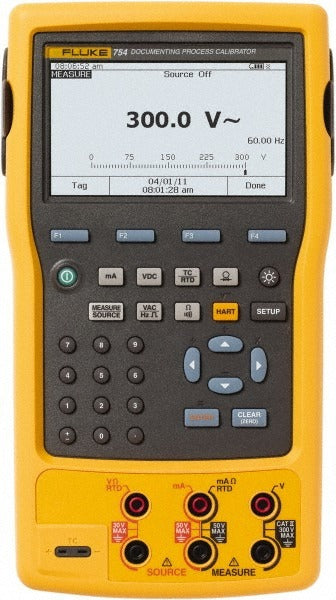
Fluke FLUKE-754 Documenting Process Calibrator

Availability:
In Stock
Ships same day if ordered by 12 pm
- $12,678.29
- $12,678.29
- Unit price
- / per
✓
Better Price in Cart
Manufacturer pricing rules prevent us from advertising our discount — no account or email required to see it.
-
Secure Payments
-
Easy Returns
-
Expert Advice
-
Fast Shipping
Product Description
The FLUKE FLUKE-754 is a documenting process calibrator designed for calibrating and verifying process instrumentation in industrial and commercial settings. It measures DC current up to 100 milliamps (mA) and sources up to 22 mA, while also handling resistance up to 10,000 ohms and frequency signals up to 50 kHz. The unit supports voltage measurements up to 300 VAC and 300 VDC, making it a versatile tool for multi-signal loop calibration. Instrumentation technicians and process control specialists use this calibrator to verify transmitters, sensors, and control loops to traceable accuracy standards. It carries a 3-year manufacturer warranty.
The FLUKE-754 is suited for industrial process environments where technicians need to source and measure electrical signals across loops involving pressure transmitters, temperature sensors, and flow instrumentation. It supports 8 RTD temperature types and 13 thermocouple (TC) types, covering a wide range of temperature sensor calibration tasks. The Min/Max capture function aids in detecting signal excursions during live process testing. Typical applications include loop calibration, HART communicator tasks, and transmitter verification in plant maintenance and instrument shops.
Key Features
- Measures DC current up to 100 mA and sources up to 22 mA for full-loop calibration
- Handles resistance measurement up to 10,000 ohms and frequency up to 50 kHz
- Supports 8 RTD types and 13 thermocouple types for broad temperature sensor coverage
- Measures and sources up to 300 VAC and 300 VDC
- Min/Max function captures signal excursions during live process monitoring
- Documenting capability supports traceable calibration records
- Backed by a 3-year manufacturer warranty
Compatibility
Designed for use with process instrumentation including pressure transmitters, temperature transmitters, and flow meters that operate on standard 4-20 mA loops and common RTD or thermocouple sensor types in industrial process control applications.
Installation Notes
This calibrator is installed and operated by licensed instrumentation or process control technicians. De-energize and isolate the loop under test before connecting leads, following site lockout/tagout procedures. Verify that source and measure ranges are correctly selected before applying signals to live instrumentation. Refer to applicable industry calibration standards and facility safety protocols when performing on-site calibration work.
Technical Specifications

Complete your install
We pulled together the parts most installs need for this unit, plus a few add-ons worth a look. Check what you need — nothing here blocks checkout.
Loading install accessories...
Add install kit to cart
—
Related Products
- Choosing a selection results in a full page refresh.