


Search
-
HVAC Equipment
-
Ductless Mini Splits
- Ductless Mini Splits
- Shop By Zone
- Shop by BTU
- Shop By Brand
- Components
- Accessories
-
HVAC Parts & Supplies
- HVAC Parts & Supplies
- HVAC Supplies
- HVAC Tools
-
HVAC Replacement Parts
- Blower Housing & Assemblies
- Blower Wheels
- Breakers, Contactors & Disconnects
- Capacitors & Transformers
- Control & Circuit Boards
- Filter Driers & Accumulators
- Gas Valves & Conversion Kits
- Heat Exchangers
- Thermal Expansion Valves (TXV)
- Temperature Controls
- Wall Brackets & Parts
- Miscellaneous Parts
- O-Rings & Gaskets
- Hydronics
- Motors
- Thermostats & Zoning
-
Plumbing
-
Pool
-
Electrical
-
Air Quality
-
Tools & Supplies
-
Door Security & Hardware


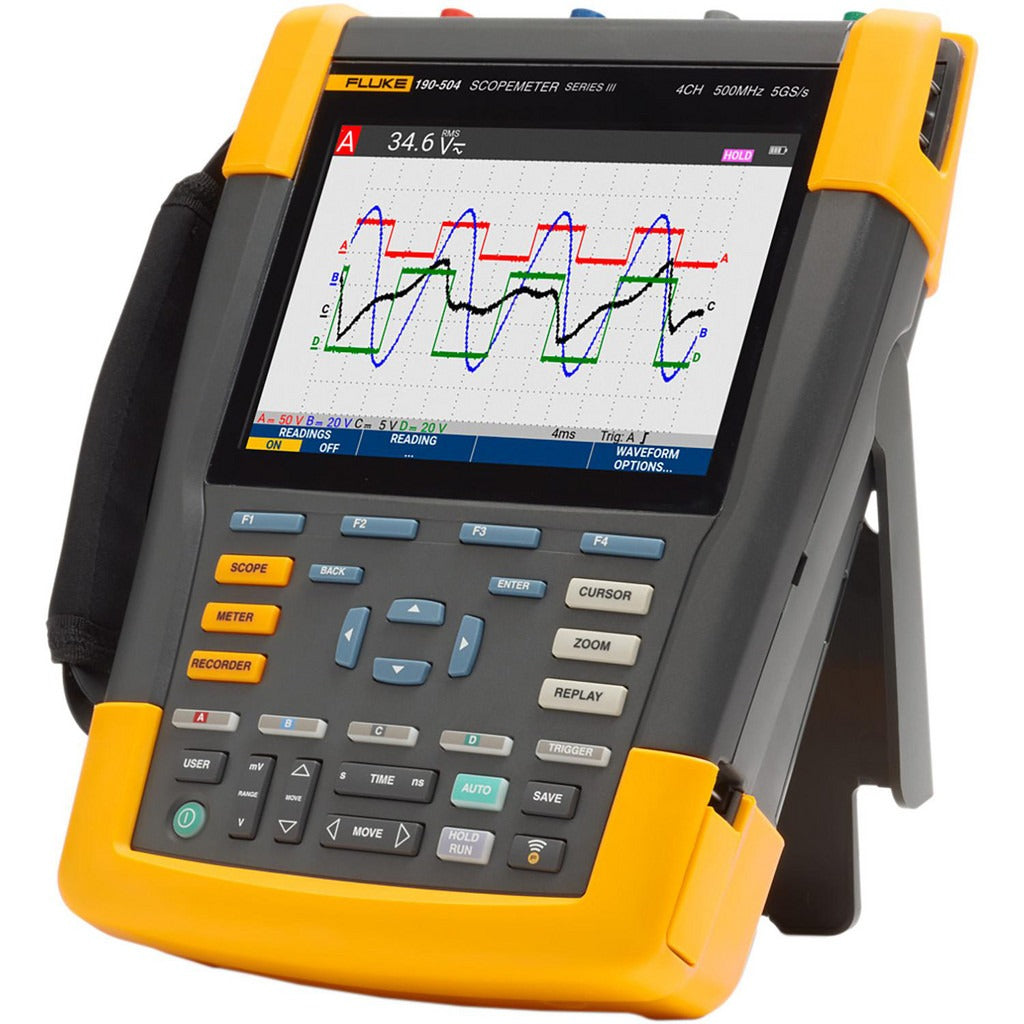
Fluke FLUKE-190-504-III Portable Oscilloscope 500 Mhz 4ch

Availability:
Out Of Stock
- $9,955.34
- $9,955.34
- Unit price
- / per
✓
Better Price in Cart
Manufacturer pricing rules prevent us from advertising our discount — no account or email required to see it.
-
Secure Payments
-
Easy Returns
-
Expert Advice
-
Fast Shipping
Product Description
The FLUKE FLUKE-190-504-III is a portable oscilloscope designed for field diagnostics and bench troubleshooting across electrical, HVAC, and industrial control applications. It delivers a 500 MHz bandwidth across 4 independent channels, giving technicians the ability to capture and compare multiple signals simultaneously. The LCD display provides clear waveform visualization in a range of lighting conditions. Vertical deflection ranges from 2 millivolts per division to 100 millivolts per division, supporting both low-level signal tracing and higher-amplitude measurements. This instrument is intended for use by licensed electricians, controls technicians, and instrumentation specialists who require a portable, multi-channel measurement tool in the field.
The FLUKE-190-504-III suits residential and commercial service work where panel-level electrical diagnostics, motor drive analysis, variable frequency drive troubleshooting, and building automation system signal verification are required. Its portable form factor makes it appropriate for on-site commissioning and service calls where bench equipment is not practical. Technicians working on low-voltage controls, ECM motor circuits, and industrial automation wiring will find the 4-channel configuration particularly useful for comparing input and output signals in real time.
Key Features
- 500 MHz bandwidth supports high-frequency signal capture on modern drive and control circuits
- 4 independent channels allow simultaneous multi-signal comparison
- Vertical deflection range of 2 mV/div to 100 mV/div accommodates a wide range of signal amplitudes
- LCD display for clear waveform readout in field conditions
- Portable form factor suited for on-site electrical and controls diagnostics
Compatibility
Designed as a portable, general-purpose oscilloscope for field and bench use in electrical, controls, and instrumentation service applications.
Installation Notes
This oscilloscope is a handheld diagnostic instrument and does not require permanent installation. Before connecting probes to any live circuit, verify that the instrument's rated input voltage and category rating are appropriate for the circuit under test in accordance with NFPA 70E and NEC safe work practices. Power down or de-energize equipment only when the diagnostic procedure allows; follow all applicable lockout/tagout procedures when direct circuit contact is required. Instrument calibration and probe compensation should be verified before critical measurements.
Technical Specifications

Complete your install
We pulled together the parts most installs need for this unit, plus a few add-ons worth a look. Check what you need — nothing here blocks checkout.
Loading install accessories...
Add install kit to cart
—
Related Products
- Choosing a selection results in a full page refresh.