


Search
-
HVAC Equipment
-
Ductless Mini Splits
- Ductless Mini Splits
- Shop By Zone
- Shop by BTU
- Shop By Brand
- Components
- Accessories
-
HVAC Parts & Supplies
- HVAC Parts & Supplies
- HVAC Supplies
- HVAC Tools
-
HVAC Replacement Parts
- Blower Housing & Assemblies
- Blower Wheels
- Breakers, Contactors & Disconnects
- Capacitors & Transformers
- Control & Circuit Boards
- Filter Driers & Accumulators
- Gas Valves & Conversion Kits
- Heat Exchangers
- Thermal Expansion Valves (TXV)
- Temperature Controls
- Wall Brackets & Parts
- Miscellaneous Parts
- O-Rings & Gaskets
- Hydronics
- Motors
- Thermostats & Zoning
-
Plumbing
-
Pool
-
Electrical
-
Air Quality
-
Tools & Supplies
-
Door Security & Hardware


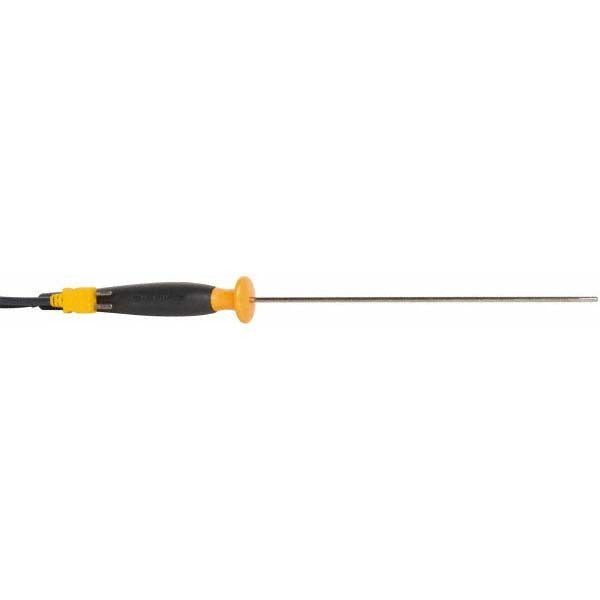
Fluke 80PK-22 Type K Immersion Thermocouple Probe

Availability:
In Stock
Ships same day if ordered by 12 pm
- $194.09
- $194.09
- Unit price
- / per
✓
Better Price in Cart
Manufacturer pricing rules prevent us from advertising our discount — no account or email required to see it.
-
Secure Payments
-
Easy Returns
-
Expert Advice
-
Fast Shipping
Product Description
The FLUKE 80PK-22 is a Type K immersion thermocouple probe designed for direct temperature measurement of liquids and gels. The probe features an 8.375-inch stainless sheath with a 0.13-inch diameter, allowing insertion into tanks, pipes, and process vessels. Rated from -320 to 1,944 degrees F (-196 to 1,090 degrees C), it covers a wide range of industrial and HVAC applications. A straight PVC-coated cable terminates in a standard K-type connector, making it compatible with any K-type thermocouple meter or data logger. Response time is 3 seconds. HVAC technicians, process technicians, and service pros install this probe for field diagnostics and system commissioning.
The 80PK-22 is suited for general-purpose temperature measurement wherever a K-type immersion probe is needed. Common applications include measuring fluid temperatures in HVAC hydronic systems, chiller loops, boiler feed lines, and industrial process tanks. Its slim 0.13-inch sheath diameter allows insertion through small access ports. The straight PVC cable handles routine service environments without stiffness issues. This probe is a standard field instrument for any technician who requires accurate liquid or gel temperature readings with a K-type compatible instrument.
Key Features
- Wide temperature range: -320 to 1,944 degrees F (-196 to 1,090 degrees C)
- 8.375-inch sheath length for adequate immersion depth in tanks and pipes
- Slim 0.13-inch sheath diameter fits small access ports and sample containers
- 3-second response time for fast, reliable readings
- Straight PVC-coated cable resists common field fluids
- Standard K-type connector fits any compatible thermocouple meter or data logger
- One-year manufacturer warranty
Compatibility
Designed for use with any K-type thermocouple meter, data logger, or controller that accepts a standard K-type miniature or standard connector. Suitable for liquids and gels in most general temperature measurement applications.
Installation Notes
Installation is performed by qualified HVAC technicians or instrumentation professionals. Before inserting the probe into a pressurized line or vessel, relieve system pressure and allow hot fluids to cool to a safe handling temperature. Insert the sheath fully to the measurement point to achieve accurate readings and the rated 3-second response time. Do not bend the sheath or exceed the rated temperature range, as damage to the probe or connector may result.
Technical Specifications

Complete your install
We pulled together the parts most installs need for this unit, plus a few add-ons worth a look. Check what you need — nothing here blocks checkout.
Loading install accessories...
Add install kit to cart
—
Related Products
- Choosing a selection results in a full page refresh.