


Search
-
HVAC Equipment
-
Ductless Mini Splits
- Ductless Mini Splits
- Shop By Zone
- Shop by BTU
- Shop By Brand
- Components
- Accessories
-
HVAC Parts & Supplies
- HVAC Parts & Supplies
- HVAC Supplies
- HVAC Tools
-
HVAC Replacement Parts
- Blower Housing & Assemblies
- Blower Wheels
- Breakers, Contactors & Disconnects
- Capacitors & Transformers
- Control & Circuit Boards
- Filter Driers & Accumulators
- Gas Valves & Conversion Kits
- Heat Exchangers
- Thermal Expansion Valves (TXV)
- Temperature Controls
- Wall Brackets & Parts
- Miscellaneous Parts
- O-Rings & Gaskets
- Hydronics
- Motors
- Thermostats & Zoning
-
Plumbing
-
Pool
-
Electrical
-
Air Quality
-
Tools & Supplies
-
Door Security & Hardware


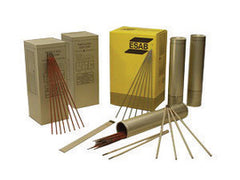
Esab 255011413 E7018 Carbon Steel Electrode 1/4 in 50 Lb

Availability:
In Stock
Ships via freight in 1-3 business days
- $423.43
- $423.43
- Unit price
- / per
✓
Better Price in Cart
Manufacturer pricing rules prevent us from advertising our discount — no account or email required to see it.
LTL Delivery
This product weighs 52 lb each and will be shipped via LTL carrier. A lift gate option will be added free of charge for your convenience.
-
Secure Payments
-
Easy Returns
-
Expert Advice
-
Fast Shipping
Product Description
The ESAB 255011413 is a low-hydrogen, moisture-resistant carbon steel welding electrode designed for all-position welding of carbon and low alloy steels, including hardenable steels. Measuring 1/4 inch in diameter and 18 inches in length, these E7018 electrodes are packed in a 50 lb hermetically sealed can to protect against moisture absorption during storage. The formulation produces smooth weld metal transfer, wider operating ranges, and minimized post-weld cleanup. Certified to AWS A5.1 E7018H4R and ASME SFA 5.1, this electrode is suited for structural, pressure vessel, and heavy fabrication work performed by certified welders and welding professionals.
These electrodes are used in industrial and commercial welding applications where carbon and low alloy steel joints require low-hydrogen deposits to reduce cracking risk. The all-position classification supports flat, horizontal, vertical, and overhead welds. Preheat is required when welding heavy sections or hardenable steels to prevent hard heat-affected zones and suppress quench cracking on cooling. Typical applications include structural steel fabrication, heavy equipment repair, and pressure-rated assemblies where compliance with military, classification society, or code specifications is required.
Key Features
- Low-hydrogen, moisture-resistant coating reduces risk of hydrogen-induced cracking
- All-position E7018 classification supports flat, horizontal, vertical, and overhead welds
- Hermetically sealed 50 lb can maintains electrode integrity during storage and transport
- Smooth weld metal transfer minimizes post-weld cleanup and spatter
- Wider operating ranges provide flexibility across varying base metal thicknesses
- Preheat capability supports welding of hardenable steels and heavy sections
Compatibility
Certified to AWS A5.1 E7018H4R, ASME SFA 5.1, QPL-22200/1, MIL-7018, A.B.S.-2Y/AWS A5.1 E7018, D.N.V.-3Y (H10), L.R.-3m/3Ym (H10), and C.W.B.-CSA W48. Suitable for carbon and low alloy steels including a variety of hardenable steel grades.
Installation Notes
Installation and use by a qualified welder or certified welding professional is recommended, particularly for code-governed work covered under AWS D1.1 or ASME Section IX. Store electrodes in a dry environment and use a rod oven to maintain low-hydrogen conditions prior to welding when required by procedure. Apply appropriate preheat when welding heavy sections or hardenable steels as directed by the applicable welding procedure specification. Inspect the hermetically sealed can for damage before opening to ensure moisture protection has not been compromised.
Technical Specifications

Complete your install
We pulled together the parts most installs need for this unit, plus a few add-ons worth a look. Check what you need — nothing here blocks checkout.
Loading install accessories...
Add install kit to cart
—
Related Products
- Choosing a selection results in a full page refresh.