


Search
-
HVAC Equipment
-
Ductless Mini Splits
- Ductless Mini Splits
- Shop By Zone
- Shop by BTU
- Shop By Brand
- Components
- Accessories
-
HVAC Parts & Supplies
- HVAC Parts & Supplies
- HVAC Supplies
- HVAC Tools
-
HVAC Replacement Parts
- Blower Housing & Assemblies
- Blower Wheels
- Breakers, Contactors & Disconnects
- Capacitors & Transformers
- Control & Circuit Boards
- Filter Driers & Accumulators
- Gas Valves & Conversion Kits
- Heat Exchangers
- Thermal Expansion Valves (TXV)
- Temperature Controls
- Wall Brackets & Parts
- Miscellaneous Parts
- O-Rings & Gaskets
- Hydronics
- Motors
- Thermostats & Zoning
-
Plumbing
-
Pool
-
Electrical
-
Air Quality
-
Tools & Supplies
-
Door Security & Hardware


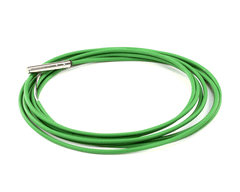
Electrolux 96125 Ntc Temperature Probe Green Defrost

Availability:
Out Of Stock
- $53.95
- $53.95
- Unit price
- / per
✓
Better Price in Cart
Manufacturer pricing rules prevent us from advertising our discount — no account or email required to see it.
-
Secure Payments
-
Easy Returns
-
Expert Advice
-
Fast Shipping
Product Description
The ELECTROLUX 96125 is an NTC (negative temperature coefficient) temperature probe used in commercial refrigeration and food service equipment. It monitors temperature at a specific point in the refrigeration circuit and sends a resistance-based signal to the unit control board, triggering defrost cycles or alarm conditions as needed. The probe body measures 6 by 40 millimeters and ships with a 3000 millimeter lead wire, giving technicians ample reach for routing through cabinet panels or equipment frames. The green color coding identifies this sensor as a defrost-cycle probe, distinguishing it from other NTC sensors in multi-probe installations. Installation is typically performed by commercial refrigeration technicians.
This probe is designed for use in commercial refrigeration applications including reach-in coolers, blast chillers, display cases, and similar Electrolux commercial appliance platforms. Its extended lead length makes it well-suited for larger cabinet installations where the sensor must be routed from an evaporator coil to a remotely mounted controller. The green color designation follows common industry sensor-coding conventions for defrost probes, aiding in correct identification during service and replacement.
Key Features
- NTC technology provides continuous, accurate temperature sensing with no moving parts
- Probe body dimensions of 6 by 40 millimeters fit standard sensor mounting brackets and clips
- 3000 millimeter lead wire reduces the need for splicing in deep-cabinet or remote-mount installations
- Green color coding identifies this unit as a defrost sensor in multi-probe systems
- OEM Electrolux part number ensures direct fit in compatible commercial equipment
Compatibility
Designed as an OEM-style replacement NTC defrost probe for Electrolux commercial refrigeration equipment. Refer to your equipment service manual or the OEM parts lookup tool to confirm fitment for your specific model before installation.
Installation Notes
Commercial refrigeration technicians should power down and unplug the unit, or lock out the electrical supply per NFPA 70E lockout-tagout procedures, before removing or installing any temperature probe. Disconnect the existing probe connector at the control board, route the new lead along the same path as the original, and secure it away from sharp edges or moving parts. Do not kink or crush the lead wire, as this can alter sensor resistance and cause false temperature readings. Verify proper probe seating in the mounting clip or bracket before restoring power and running a functional test.
Technical Specifications

Complete your install
We pulled together the parts most installs need for this unit, plus a few add-ons worth a look. Check what you need — nothing here blocks checkout.
Loading install accessories...
Add install kit to cart
—
Related Products
- Choosing a selection results in a full page refresh.