


Search
-
HVAC Equipment
-
Ductless Mini Splits
- Ductless Mini Splits
- Shop By Zone
- Shop by BTU
- Shop By Brand
- Components
- Accessories
-
HVAC Parts & Supplies
- HVAC Parts & Supplies
- HVAC Supplies
- HVAC Tools
-
HVAC Replacement Parts
- Blower Housing & Assemblies
- Blower Wheels
- Breakers, Contactors & Disconnects
- Capacitors & Transformers
- Control & Circuit Boards
- Filter Driers & Accumulators
- Gas Valves & Conversion Kits
- Heat Exchangers
- Thermal Expansion Valves (TXV)
- Temperature Controls
- Wall Brackets & Parts
- Miscellaneous Parts
- O-Rings & Gaskets
- Hydronics
- Motors
- Thermostats & Zoning
-
Plumbing
-
Pool
-
Electrical
-
Air Quality
-
Tools & Supplies
-
Door Security & Hardware


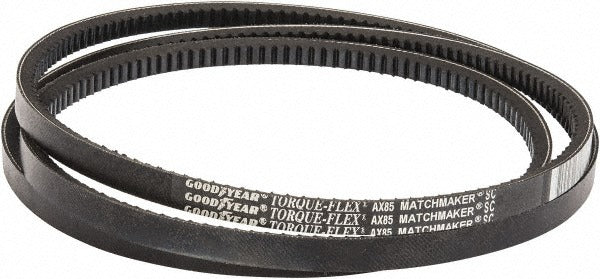
Continental Contitech 20039524 Ax Section Cogged V-belt AX85
Availability:
In Stock

Ships same day if ordered by 12 pm
- $47.42
- $47.42
- Unit price
- / per
✓
Better Price in Cart
Manufacturer pricing rules prevent us from advertising our discount — no account or email required to see it.
-
Secure Payments
-
Easy Returns
-
Expert Advice
-
Fast Shipping
Product Description
The CONTINENTAL CONTITECH 20039524 is a cogged AX-section V-belt designed for high-torque power transmission applications in HVAC, industrial, and mechanical equipment. Manufactured under the Torque-Flex design profile, this belt features a Fiber-Reinforced Vytracord construction that delivers durability and flex strength in demanding drive systems. The outside length measures 87.2 inches with a belt internal length of 86.30 inches. The cogged profile reduces bending resistance and heat buildup, improving efficiency in variable-speed and high-load drives. Oil-resistant compound construction helps the belt hold up in environments where incidental fluid exposure is a concern. Weighing 0.6 pounds, this belt ships as a single unit and is sold individually.
This belt suits residential and light commercial HVAC systems, refrigeration units, air handlers, compressors, fans, and general industrial drive applications that specify an AX-section cogged belt. The Torque-Flex cogged design makes it a direct-fit candidate for drives where a standard wrapped AX belt has been used but improved flex and reduced heat are priorities. It carries the belt number AX85, which is the conventional industry designation for this size and section. Technicians working on blower drives, condenser fan assemblies, and belt-driven equipment will encounter this size regularly in both OEM and replacement scenarios.
Key Features
- AX-section cogged profile reduces bending resistance and improves drive efficiency
- Fiber-Reinforced Vytracord construction provides tensile strength and dimensional stability
- Oil-resistant compound resists degradation from incidental fluid contact
- Torque-Flex design supports high-torque and variable-load drive conditions
- Rated for operating temperatures from -40 degrees F to approximately 140 degrees F (-40C to 60C)
- Outside length 87.2 inches with internal length 86.30 inches for precise drive sizing
Compatibility
This belt is identified by belt number AX85 and is designed as a replacement for drives specifying an AX-section cogged V-belt with an 87.2-inch outside length. Confirm drive sheave geometry and center distance against the AX85 designation before installation.
Installation Notes
Belt replacement on HVAC and mechanical drive systems should be performed by a qualified technician with the unit fully de-energized and locked out per OSHA lockout/tagout procedures. Adjust drive center distance to allow belt seating without forcing it over sheave flanges, then tension to manufacturer specification using a tension gauge. Inspect sheaves for wear or misalignment before installing a new belt, as worn grooves accelerate belt failure. Never pry a belt onto a sheave with a tool that could nick or cut the belt carcass.
Technical Specifications

Complete your install
We pulled together the parts most installs need for this unit, plus a few add-ons worth a look. Check what you need — nothing here blocks checkout.
Loading install accessories...
Add install kit to cart
—
Related Products
- Choosing a selection results in a full page refresh.