


Search
-
HVAC Equipment
-
Ductless Mini Splits
- Ductless Mini Splits
- Shop By Zone
- Shop by BTU
- Shop By Brand
- Components
- Accessories
-
HVAC Parts & Supplies
- HVAC Parts & Supplies
- HVAC Supplies
- HVAC Tools
-
HVAC Replacement Parts
- Blower Housing & Assemblies
- Blower Wheels
- Breakers, Contactors & Disconnects
- Capacitors & Transformers
- Control & Circuit Boards
- Filter Driers & Accumulators
- Gas Valves & Conversion Kits
- Heat Exchangers
- Thermal Expansion Valves (TXV)
- Temperature Controls
- Wall Brackets & Parts
- Miscellaneous Parts
- O-Rings & Gaskets
- Hydronics
- Motors
- Thermostats & Zoning
-
Plumbing
-
Pool
-
Electrical
-
Air Quality
-
Tools & Supplies
-
Door Security & Hardware


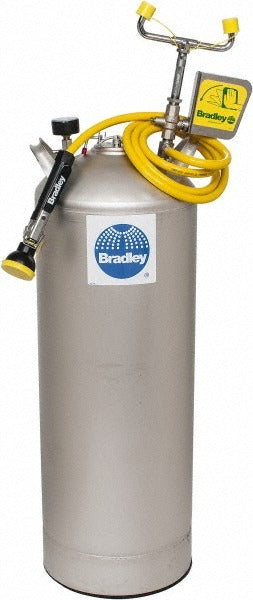
Bradley S19-788 Portable Eye Wash Station 15 Gal
Availability:
In Stock

Ships same day if ordered by 12 pm
- $3,634.20
- $3,634.20
- Unit price
- / per
✓
Better Price in Cart
Manufacturer pricing rules prevent us from advertising our discount — no account or email required to see it.
-
Secure Payments
-
Easy Returns
-
Expert Advice
-
Fast Shipping
Product Description
The BRADLEY S19-788 is a self-contained, pressurized portable eye wash station built for job sites, laboratories, and industrial facilities where a fixed plumbed unit is not practical. It holds 15 gallons of flushing fluid and delivers a regulated flow rate of 0.4 gallons per minute at 30 psi, providing a minimum 18-minute continuous flush duration that meets ANSI Z358.1 duration requirements. The tank and body are constructed from stainless steel for corrosion resistance in demanding environments. A drench hose is included for supplemental face and body rinsing. Safety coordinators, industrial hygienists, and facility maintenance crews typically deploy and maintain this unit.
This unit is suited for portable emergency eyewash applications in construction, manufacturing, chemical handling, and utility environments where proximity to a plumbed water source cannot be guaranteed. The pressurized design eliminates the need for an external water connection at the point of use. It ships ready to fill and deploy. The included inspection tag supports routine compliance documentation, and the universal identification sign makes the station easy to locate in an emergency.
Key Features
- 15-gallon stainless steel tank delivers 18-minute minimum flush duration
- Pressurized design — no plumbing connection required at point of use
- 0.4 GPM flow rate at 30 psi for consistent, controlled flushing
- Includes drench hose for supplemental face and body rinsing
- Ships with inspection tag, protective dust cover, and universal identification sign
- Portable configuration supports temporary job sites and rotating work areas
Compatibility
Designed as a self-contained portable emergency eye wash station for general industrial, commercial, and construction site applications requiring on-demand first-aid eye flushing capability without a fixed plumbing connection.
Installation Notes
Placement and maintenance of emergency eye wash stations is governed by ANSI Z358.1 — consult the current standard for required travel distance, clearance, and inspection intervals. Fill the tank with clean potable water or a preserved flushing solution appropriate for the service environment before placing the unit in service. Inspect the unit at the recommended interval using the included inspection tag and replace flushing fluid per the manufacturer and ANSI guidelines. Keep the protective dust cover in place when the station is not in active use to prevent contamination.
Technical Specifications

Complete your install
We pulled together the parts most installs need for this unit, plus a few add-ons worth a look. Check what you need — nothing here blocks checkout.
Loading install accessories...
Add install kit to cart
—
Related Products
- Choosing a selection results in a full page refresh.