


Search
-
HVAC Equipment
-
Ductless Mini Splits
- Ductless Mini Splits
- Shop By Zone
- Shop by BTU
- Shop By Brand
- Components
- Accessories
-
HVAC Parts & Supplies
- HVAC Parts & Supplies
- HVAC Supplies
- HVAC Tools
-
HVAC Replacement Parts
- Blower Housing & Assemblies
- Blower Wheels
- Breakers, Contactors & Disconnects
- Capacitors & Transformers
- Control & Circuit Boards
- Filter Driers & Accumulators
- Gas Valves & Conversion Kits
- Heat Exchangers
- Thermal Expansion Valves (TXV)
- Temperature Controls
- Wall Brackets & Parts
- Miscellaneous Parts
- O-Rings & Gaskets
- Hydronics
- Motors
- Thermostats & Zoning
-
Plumbing
-
Pool
-
Electrical
-
Air Quality
-
Tools & Supplies
-
Door Security & Hardware


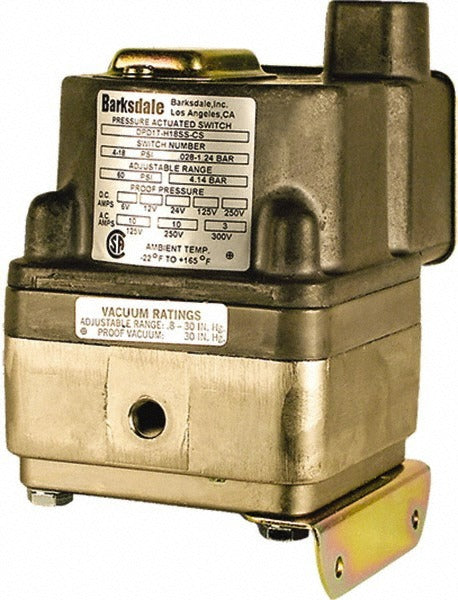
Barksdale DPD1T-H18SS Differential Pressure Switch Spdt 60 Psi
Availability:
In Stock

Ships same day if ordered by 12 pm
- $1,281.10
- $1,281.10
- Unit price
- / per
✓
Better Price in Cart
Manufacturer pricing rules prevent us from advertising our discount — no account or email required to see it.
-
Secure Payments
-
Easy Returns
-
Expert Advice
-
Fast Shipping
Product Description
The BARKSDALE DPD1T-H18SS is a differential pressure switch designed to sense and respond to pressure differences across two points in a fluid or gas system. Built with a 300 stainless steel wetted path, it handles demanding environments where corrosion resistance is required. The switch features an SPDT contact form rated at 10 amps at 125/250 volts AC and 3 amps at 480 volts AC, covering a wide range of control circuit applications. With a maximum pressure setting of 60 psi and a repeatability rating of 0.5%, this switch delivers consistent actuation performance. It is installed by licensed HVAC technicians, industrial maintenance technicians, and instrumentation professionals in systems requiring reliable differential pressure monitoring.
The DPD1T-H18SS suits residential and commercial HVAC systems, hydraulic lines, compressed air systems, and fluid process piping where differential pressure monitoring and control are required. The 1/8 inch NPTF threaded ports allow direct connection to standard instrumentation ports. The 18-inch free leads provide wiring flexibility in tight enclosures or panel installations. Its operating temperature range of -65 degrees F to 165 degrees F makes it suitable for both low-temperature refrigeration circuits and higher-temperature process applications.
Key Features
- SPDT contact form rated 10A at 125/250 volts AC and 3A at 480 volts AC
- Maximum pressure setting of 60 psi with minimum deadband of 0.18 psi and maximum deadband of 0.32 psi
- 0.5% repeatability for consistent and reliable switching performance
- 300 stainless steel wetted materials for corrosion resistance in demanding media
- 1/8 inch NPTF threaded connection for standard instrumentation port compatibility
- 18-inch free leads for flexible wiring in confined installation spaces
- Wide operating temperature range from -65 degrees F to 165 degrees F
Compatibility
Designed as an OEM-style replacement differential pressure switch for HVAC, process, and fluid system applications requiring 1/8 inch NPTF ported differential pressure control with SPDT switching.
Installation Notes
Installation should be performed by a qualified technician familiar with instrumentation and control wiring. De-energize the control circuit and isolate system pressure before connecting or disconnecting the switch. Verify that line pressure does not exceed the 60 psi maximum pressure setting before commissioning. Follow applicable NEC requirements when routing and terminating the free-lead electrical connections.
Technical Specifications

Complete your install
We pulled together the parts most installs need for this unit, plus a few add-ons worth a look. Check what you need — nothing here blocks checkout.
Loading install accessories...
Add install kit to cart
—
Related Products
- Choosing a selection results in a full page refresh.