


Search
-
HVAC Equipment
-
Ductless Mini Splits
- Ductless Mini Splits
- Shop By Zone
- Shop by BTU
- Shop By Brand
- Components
- Accessories
-
HVAC Parts & Supplies
- HVAC Parts & Supplies
- HVAC Supplies
- HVAC Tools
-
HVAC Replacement Parts
- Blower Housing & Assemblies
- Blower Wheels
- Breakers, Contactors & Disconnects
- Capacitors & Transformers
- Control & Circuit Boards
- Filter Driers & Accumulators
- Gas Valves & Conversion Kits
- Heat Exchangers
- Thermal Expansion Valves (TXV)
- Temperature Controls
- Wall Brackets & Parts
- Miscellaneous Parts
- O-Rings & Gaskets
- Hydronics
- Motors
- Thermostats & Zoning
-
Plumbing
-
Pool
-
Electrical
-
Air Quality
-
Tools & Supplies
-
Door Security & Hardware


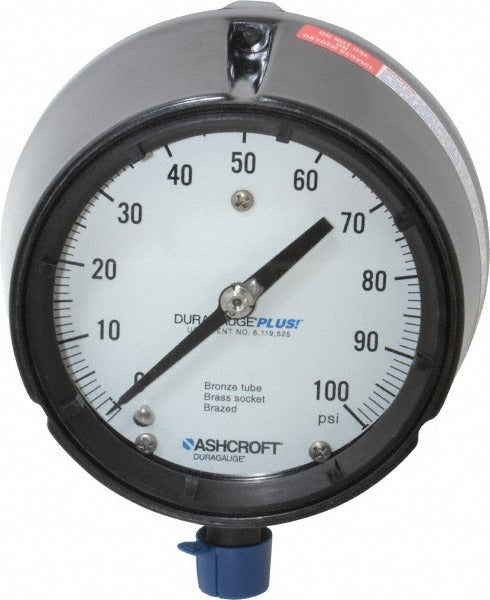
Ashcroft 96225 Pressure Gauge 4.5 in Dial 0-100 Psi Rear Flange

Availability:
In Stock
Ships same day if ordered by 12 pm
- $406.82
- $406.82
- Unit price
- / per
✓
Better Price in Cart
Manufacturer pricing rules prevent us from advertising our discount — no account or email required to see it.
-
Secure Payments
-
Easy Returns
-
Expert Advice
-
Fast Shipping
Product Description
The ASHCROFT 96225 is an analog pressure gauge designed for monitoring system pressure in a wide range of industrial and mechanical applications. It features a 4.5-inch dial for clear, at-a-glance readings and a thermoplastic case that resists corrosion and impact in field environments. The gauge covers a pressure range of 0 to 100 psi with an accuracy of 0.5 percent of scale, making it suitable for applications where reliable pressure indication is required. It is not liquid-filled, which keeps weight low and simplifies installation. Rear flange mounting allows the gauge to be panel-mounted or surface-mounted directly against a bulkhead or enclosure wall.
This gauge is appropriate for residential and light commercial mechanical systems including HVAC equipment, compressed air lines, water systems, and process piping where a durable, readable pressure indicator is needed. The rear flange mount configuration is commonly used when the gauge body must sit flush against a panel or mounting surface. The 0.5-inch threaded connection provides a standard interface to most system ports and fittings. Licensed plumbers, HVAC technicians, and mechanical contractors typically specify this style of gauge for permanent panel installations and test stations.
Key Features
- 4.5-inch analog dial for clear pressure readings at distance
- 0 to 100 psi pressure range with 0.5 percent of scale accuracy
- Rear flange mount configuration for panel and surface installations
- Thermoplastic case construction for corrosion resistance and reduced weight
- Non-liquid-filled design simplifies installation and reduces overall weight
- 0.5-inch threaded connection for standard fitting compatibility
Compatibility
Designed as an OEM-style replacement or new-installation pressure gauge for mechanical systems requiring a 4.5-inch rear-flange-mount analog gauge with a 0.5-inch threaded port connection.
Installation Notes
Installation should be performed by a qualified HVAC technician, plumber, or mechanical contractor in accordance with applicable local codes and the system manufacturer guidelines. De-pressurize and isolate the system completely before removing any existing gauge or fitting the new gauge. Apply appropriate thread sealant to the male threads per the system requirements and hand-tighten before using a wrench to avoid overtorquing the thermoplastic-adjacent fittings. Verify the gauge reads zero before re-pressurizing the system.
Technical Specifications

Complete your install
We pulled together the parts most installs need for this unit, plus a few add-ons worth a look. Check what you need — nothing here blocks checkout.
Loading install accessories...
Add install kit to cart
—
Related Products
- Choosing a selection results in a full page refresh.