


Search
-
HVAC Equipment
-
Ductless Mini Splits
- Ductless Mini Splits
- Shop By Zone
- Shop by BTU
- Shop By Brand
- Components
- Accessories
-
HVAC Parts & Supplies
- HVAC Parts & Supplies
- HVAC Supplies
- HVAC Tools
-
HVAC Replacement Parts
- Blower Housing & Assemblies
- Blower Wheels
- Breakers, Contactors & Disconnects
- Capacitors & Transformers
- Control & Circuit Boards
- Filter Driers & Accumulators
- Gas Valves & Conversion Kits
- Heat Exchangers
- Thermal Expansion Valves (TXV)
- Temperature Controls
- Wall Brackets & Parts
- Miscellaneous Parts
- O-Rings & Gaskets
- Hydronics
- Motors
- Thermostats & Zoning
-
Plumbing
-
Pool
-
Electrical
-
Air Quality
-
Tools & Supplies
-
Door Security & Hardware


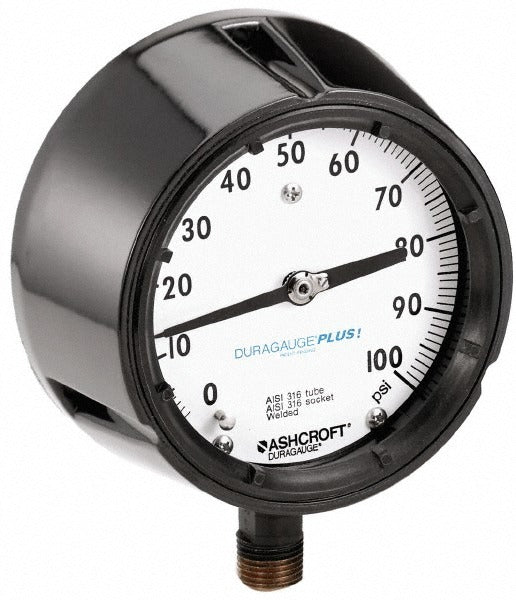

Ashcroft 96221 Pressure Gauge 0-400 Psi 4.5 in Rear Flange

Availability:
In Stock
Ships same day if ordered by 12 pm
- $331.71
- $331.71
- Unit price
- / per
✓
Better Price in Cart
Manufacturer pricing rules prevent us from advertising our discount — no account or email required to see it.
-
Secure Payments
-
Easy Returns
-
Expert Advice
-
Fast Shipping
Product Description
The ASHCROFT 96221 is a process industrial pressure gauge designed for demanding fluid and gas system monitoring applications. It features a 4.5-inch analog dial with a measurement range of 0 to 400 psi and delivers 0.5% of scale accuracy. The thermoplastic case provides resistance to corrosive environments, and the glass lens protects the dial face. Connection is made via a 0.25-inch MNPT rear entry fitting, with a rear flange mount configuration for panel or bulkhead installation. Licensed plumbers, HVAC technicians, and industrial piping mechanics commonly specify this gauge for process lines where accurate pressure readings and robust housing are required.
This gauge is suited for process and industrial piping systems in both commercial and industrial settings. The rear flange mount design allows it to be recessed into panels or mounted flush to pipe supports, keeping the dial face visible and accessible. The no-fill, non-liquid-filled construction makes it appropriate for applications where fluid dampening is not required or where process fluid compatibility with oil fill would be a concern. Typical installation scenarios include hydraulic lines, compressed air systems, water distribution panels, and chemical process equipment where a durable, panel-mounted pressure indicator is needed.
Key Features
- 4.5-inch analog dial with 0 to 400 psi range for clear, wide-view pressure reading
- 0.5% of scale accuracy for reliable process monitoring
- Thermoplastic case rated to IP66 and NEMA 4X for washdown and corrosive environments
- Rear flange mount configuration for panel or bulkhead installations
- 0.25-inch MNPT rear entry connection for direct pipe or manifold mounting
- No-fill design eliminates liquid compatibility concerns
- CRN certified for use in Canadian pressure vessel and piping applications
Compatibility
Designed as an OEM-style replacement or direct-install process pressure gauge for industrial and commercial piping systems requiring a 4.5-inch rear flange mount gauge with 0.25-inch MNPT connection and a 0 to 400 psi range.
Installation Notes
Installation should be performed by a licensed plumber or qualified industrial piping mechanic in accordance with applicable local codes and ASME B40.100 pressure gauge standards. Depressurize and isolate the system completely before removing any existing gauge or installing this unit. Apply thread sealant to the MNPT fitting per manufacturer and code requirements, and do not over-torque the connection. Verify that the process fluid, pressure range, and environmental conditions are compatible with the gauge specifications before commissioning.
Technical Specifications

Complete your install
We pulled together the parts most installs need for this unit, plus a few add-ons worth a look. Check what you need — nothing here blocks checkout.
Loading install accessories...
Add install kit to cart
—
Related Products
- Choosing a selection results in a full page refresh.