


Search
-
HVAC Equipment
-
Ductless Mini Splits
- Ductless Mini Splits
- Shop By Zone
- Shop by BTU
- Shop By Brand
- Components
- Accessories
-
HVAC Parts & Supplies
- HVAC Parts & Supplies
- HVAC Supplies
- HVAC Tools
-
HVAC Replacement Parts
- Blower Housing & Assemblies
- Blower Wheels
- Breakers, Contactors & Disconnects
- Capacitors & Transformers
- Control & Circuit Boards
- Filter Driers & Accumulators
- Gas Valves & Conversion Kits
- Heat Exchangers
- Thermal Expansion Valves (TXV)
- Temperature Controls
- Wall Brackets & Parts
- Miscellaneous Parts
- O-Rings & Gaskets
- Hydronics
- Motors
- Thermostats & Zoning
-
Plumbing
-
Pool
-
Electrical
-
Air Quality
-
Tools & Supplies
-
Door Security & Hardware


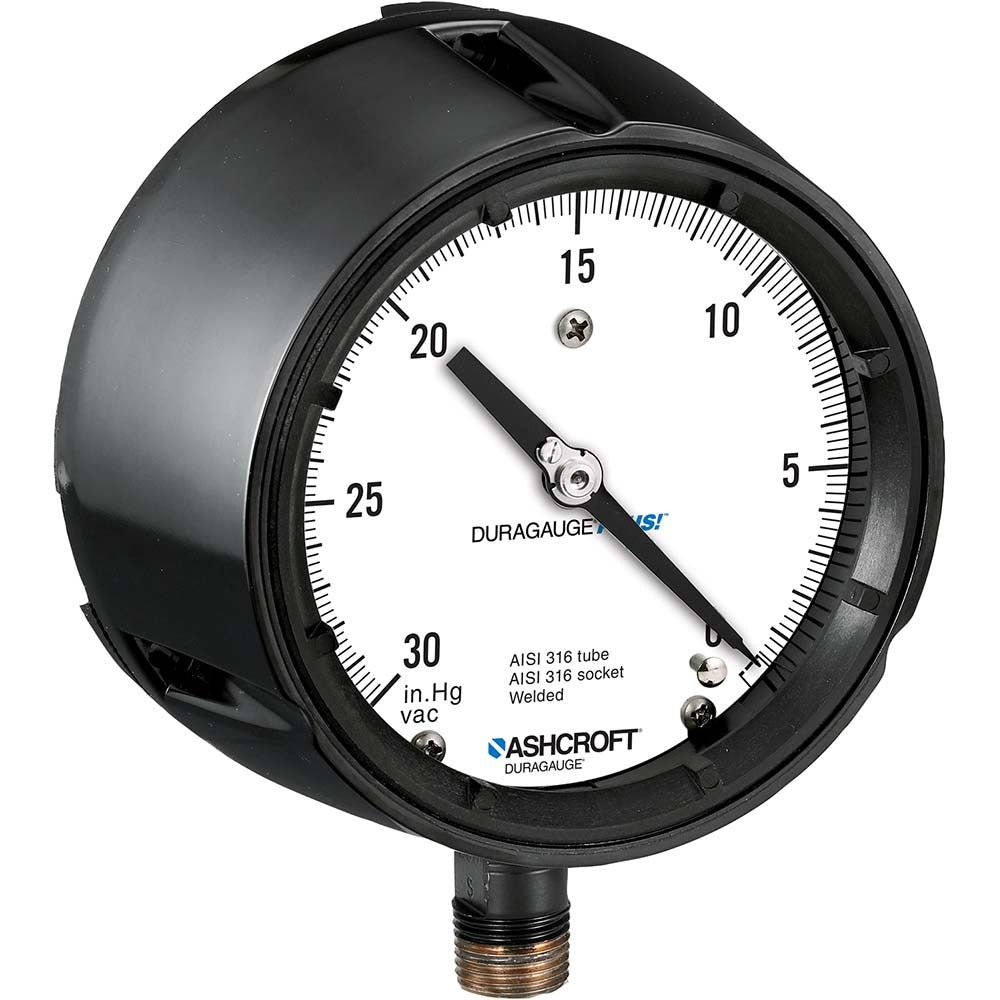
Ashcroft 94831XLL Pressure Gauge 4.5 in Dial Rear Flange

Availability:
Out Of Stock
- $490.12
- $490.12
- Unit price
- / per
✓
Better Price in Cart
Manufacturer pricing rules prevent us from advertising our discount — no account or email required to see it.
-
Secure Payments
-
Easy Returns
-
Expert Advice
-
Fast Shipping
Product Description
The ASHCROFT 94831XLL is an analog pressure gauge designed for accurate pressure measurement in industrial, mechanical, and process piping applications. It features a 4.5-inch dial face for easy readability and mounts via a rear flange configuration, making it suitable for panel or surface installations. The gauge has a 0.25-inch thread connection and delivers a stated accuracy of 0.5% of scale across a pressure range of -30 to 0 psi (vacuum range). The thermoplastic case provides a lightweight, corrosion-resistant housing. No liquid fill is used, keeping the unit straightforward to install and service. Licensed contractors and instrumentation technicians are the typical installers for this type of gauge.
This gauge is well suited for vacuum monitoring in residential, light commercial, and industrial environments where a rear flange mount is required for panel or wall installation. The 4.5-inch dial diameter provides clear, at-a-glance readings from a distance, which is useful in mechanical rooms and equipment skids. The dry (no-fill) design makes it appropriate for applications where glycerin or silicone fill is not needed or not permitted. The 0.25-inch threaded connection is a common size in plumbing and process instrumentation systems.
Key Features
- 4.5-inch analog dial face for easy remote readability
- Rear flange mount configuration for panel or surface installation
- 0.5% of scale accuracy for reliable pressure indication
- Pressure range: -30 to 0 psi (vacuum service)
- Thermoplastic case — lightweight and corrosion-resistant
- Dry gauge (no liquid fill) for simplified installation and maintenance
Compatibility
Designed as an OEM-style replacement or new-installation analog pressure gauge for plumbing, HVAC, and light industrial process systems requiring a rear flange mount with a 0.25-inch thread connection.
Installation Notes
Installation should be performed by a licensed plumber, pipefitter, or instrumentation technician in accordance with applicable local codes. Depressurize and isolate the system completely before removing the existing gauge or making any threaded connections. Apply thread sealant or PTFE tape appropriate for the service pressure and fluid before threading the gauge into the port. Do not over-tighten the threaded connection, as thermoplastic components can crack under excessive torque.
Technical Specifications

Complete your install
We pulled together the parts most installs need for this unit, plus a few add-ons worth a look. Check what you need — nothing here blocks checkout.
Loading install accessories...
Add install kit to cart
—
Related Products
- Choosing a selection results in a full page refresh.