


Search
-
HVAC Equipment
-
Ductless Mini Splits
- Ductless Mini Splits
- Shop By Zone
- Shop by BTU
- Shop By Brand
- Components
- Accessories
-
HVAC Parts & Supplies
- HVAC Parts & Supplies
- HVAC Supplies
- HVAC Tools
-
HVAC Replacement Parts
- Blower Housing & Assemblies
- Blower Wheels
- Breakers, Contactors & Disconnects
- Capacitors & Transformers
- Control & Circuit Boards
- Filter Driers & Accumulators
- Gas Valves & Conversion Kits
- Heat Exchangers
- Thermal Expansion Valves (TXV)
- Temperature Controls
- Wall Brackets & Parts
- Miscellaneous Parts
- O-Rings & Gaskets
- Hydronics
- Motors
- Thermostats & Zoning
-
Plumbing
-
Pool
-
Electrical
-
Air Quality
-
Tools & Supplies
-
Door Security & Hardware


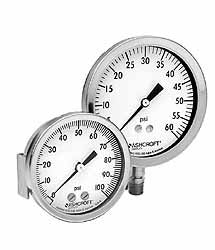
Ashcroft 82126 Pressure Gauge 0-15 Psi 2-1/2 in Dial Npt

Availability:
Out Of Stock
- $233.31
- $233.31
- Unit price
- / per
✓
Better Price in Cart
Manufacturer pricing rules prevent us from advertising our discount — no account or email required to see it.
-
Secure Payments
-
Easy Returns
-
Expert Advice
-
Fast Shipping
Product Description
The ASHCROFT 82126 is a liquid-filled industrial pressure gauge designed for accurate pressure monitoring in demanding trade applications. It features a 2-1/2 inch dial with an analog readout spanning 0 to 15 psi, with a compound range extending down to -30 inches Hg for vacuum readings. The 316 stainless steel Bourdon tube and 304/316 stainless steel case provide corrosion resistance in wet or chemically aggressive environments. Accuracy is rated at 1% of scale. The polycarbonate lens protects the dial face from moisture and impact. Licensed HVAC technicians, plumbers, and industrial service professionals install this gauge in process piping, pressure testing, and mechanical system monitoring applications.
This gauge is suited for residential and light commercial HVAC, plumbing, and industrial process systems where reliable low-pressure monitoring is required. The liquid fill dampens needle movement caused by pressure spikes and vibration, making it appropriate for pump outlets, compressor lines, and test manifold setups. The center back mount configuration with a 1/4 inch NPT connection fits standard gauge ports on equipment panels, pipe tees, and test points. It carries CRN, IP54, IP65/NEMA 4, PED, and RoHS certifications, covering a wide range of commercial and industrial installation environments.
Key Features
- Liquid-filled case dampens needle flutter on vibrating equipment and pulsating systems
- 316 stainless steel Bourdon tube resists corrosion in wet and chemically active environments
- 1% of scale accuracy for reliable pressure readings across the full 0 to 15 psi range
- Compound range from -30 inches Hg to 15 psi supports vacuum and positive pressure measurement
- IP54 and IP65/NEMA 4 ratings provide dust and water ingress protection
- Polycarbonate lens offers impact and moisture resistance for field durability
Compatibility
Designed as an OEM-style replacement or direct-install pressure gauge for industrial, HVAC, and plumbing systems requiring a 1/4 inch NPT center back mount gauge with a 2-1/2 inch dial and 0 to 15 psi range.
Installation Notes
Installation is typically performed by a licensed plumber, HVAC technician, or industrial pipefitter. Shut off system pressure and depressurize the line completely before removing or installing the gauge. Apply thread sealant rated for the system media to the 1/4 inch NPT threads and tighten to snug plus hand-tight, being careful not to overtighten and crack the gauge body. Verify the pressure range is appropriate for the system before placing the gauge in service.
Technical Specifications

Complete your install
We pulled together the parts most installs need for this unit, plus a few add-ons worth a look. Check what you need — nothing here blocks checkout.
Loading install accessories...
Add install kit to cart
—
Related Products
- Choosing a selection results in a full page refresh.